How much protein you need, and how to get it
On this page
- 1. You’re closer than you think
- 2. The gap is at breakfast and lunch
- 3. Add one lean food to the short meals
- 4. Give the protein a job
- 5. Your situation changes the details
- 6. Plants work, with a little planning
- 7. What not to worry about
- Every page in this guide
- The numbers in one table
- Is 1.2 to 1.6 too much, or too little?
- What changed since our first Protein Guide
- The simple plan

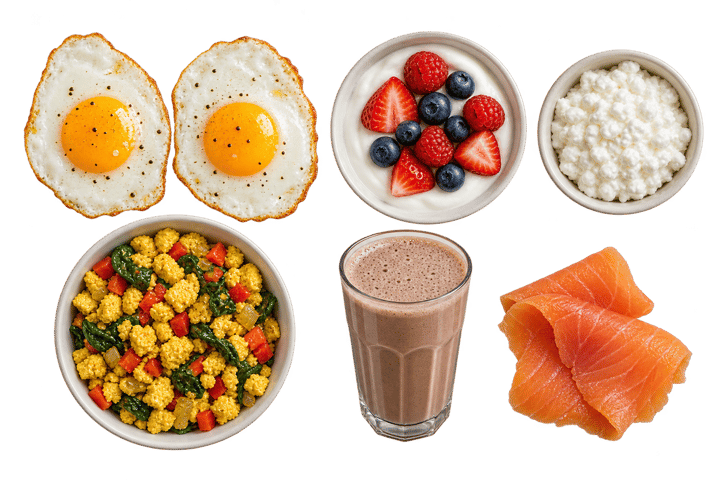
Most people aren’t far off on protein for the day. They’re short in the morning and at lunch. The average American adult eats about 77 g a day, a little under the new US range, and more than 40% of it lands at dinner, which already clears the bar on its own. So leave dinner alone and find the missing grams at the first two meals.
What we’d do
Put your weight in the daily range calculator and get your range in grams. Check breakfast and lunch against your meal line, about 0.4 g per kg of body weight, since that’s where most people come up short. Add one lean protein food to each meal that misses, like a Greek yogurt, two eggs, a can of tuna or some cottage cheese. Lift weights at least twice a week so the protein has something to build. If you have kidney disease, your doctor sets your number. The Gyroscope app personalizes yours.
If you remember three things
- Aim for 1.2 to 1.6 g per kg a day. At 180 lb that’s about 100 to 130 g. Many people are a little under.
- Breakfast and lunch are where the grams go missing. Each meal should reach about 0.4 g per kg, about 30 g at 165 lb.
- One lean food per short meal fixes most days. It costs far fewer calories than eating more of everything.
1. You’re closer than you think
You’ve heard a few protein numbers, and they don’t agree. Food labels say 50 g. The RDA says 0.8 g per kg of body weight. Gyms say a gram per pound, which is 2.2 g per kg. In January 2026 the US Dietary Guidelines picked another: 1.2 to 1.6 g per kg a day.
That last one is the range we use. The RDA is the amount that covers basic needs for nearly all healthy adults, and the gym number is the top end of what lifting trials found useful. The report behind the guidelines puts the average American adult at about 1 g per kg a day, so the average adult clears the old minimum and sits a little under the new range. For a typical adult that’s a gap of about 15 to 25 grams, roughly one Greek yogurt and an egg or two.
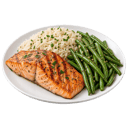

That gap is food, and if you want to and you can, food is where we’d find it. A gram from a shake counts the same, but nobody needs one to reach this range, and the guidelines behind it list foods and never mention powder.
2. The gap is at breakfast and lunch
In the latest national food survey (2021 to 2023), US adults ate 19% of their protein at breakfast, 27% at lunch, 42% at dinner and 13% in snacks. That works out to about 15 g in the morning, 21 g at midday and 32 g at night.
Protein per meal counts because muscle building after a meal levels off. In pooled lab studies, it topped out at about 0.24 g per kg of body weight in men around 22 and 0.40 in men around 71. Our meal line uses 0.4 at every age, which is the older men’s figure and the safe upper estimate for young adults. For a 165 lb adult that’s 30 g, and in the average American day only dinner gets there.
The evidence has limits. In a 12-hour lab study, four doses of 20 g beat both eight doses of 10 g and two of 40 g. But in a 2023 trial, 100 g at once kept muscle building going for more than 12 hours, and in older adults a day split evenly built no more muscle protein than a day skewed to dinner. We wouldn’t chase a perfect schedule, but breakfast and lunch are where the missing grams are easiest to add.
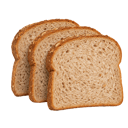
 A plain bagel


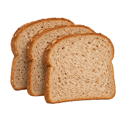 Greek yogurt, 2 eggs and toast
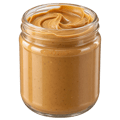 Peanut butter sandwich
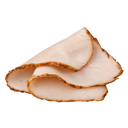
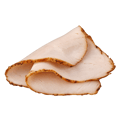 Turkey sandwich
Bring breakfast up to 32 g and lunch up to 33, like the meals in the chart, and the average American day goes from 77 g to about 106 g. For a 165 lb adult that’s inside the range of 90 to 120 g, with the same dinner. The two swaps together even come in about 40 calories under the meals they replace, 591 against 630.
3. Add one lean food to the short meals
You can reach 30 g of protein from almost any food if you eat enough of it. The difference is what comes with it. From chicken breast, 30 g costs about 150 calories. From pasta it costs about 820, and from rice about 1,450.
-
 Shrimp4 1/2 oz 124 cal
-
 Tuna, light, canned in water5 1/2 oz drained 133 cal
-
 Whey protein powder1 1/4 scoops 135 cal
-
 Cod4 1/2 oz 138 cal
-
 Turkey breast3 1/2 oz 138 cal
-
 Spaghetti4 1/4 cups 817 cal
-
 Quinoa3 3/4 cups 818 cal
-
 Almonds5 oz 819 cal
-
 Oats, dry2 3/4 cups 861 cal
-
 White rice7 cups 1,450 cal
That’s why we’d add a lean food to the short meals and leave everything else alone. Anything with about 15 g of protein per 100 calories works: shrimp, tuna, cod, turkey, chicken, egg whites, Greek yogurt, cottage cheese, seitan or a scoop of whey. If you need the calories, eating more of everything is a fine way to get there too.
4. Give the protein a job
Your muscle is never finished. In a 2022 study of adults 65 to 80, about 2% of the protein in their leg muscle was made new every day. Protein from food supplies the amino acids for that rebuilding, and lifting tells the muscle to build more than it takes apart.
In the biggest review of lifting trials, 49 trials and 1,863 people, extra protein added lean mass on top of the training, and the gains leveled off near 1.6 g per kg a day. The US activity guidelines ask every adult for at least 2 days a week of muscle work, and that’s the other half of this guide.
5. Your situation changes the details
Every situation below has its own page, with its own research and its own warnings. The idea stays the same: hit your range, get the first two meals over the line, and give the protein a job.
A few headlines from those pages. In pregnancy, the US RDA rises to 1.1 g per kg (71 g) in the second half. For building muscle, the 1.6 and 2.2 g per kg marks from the lifting trials are more useful than a gram per pound. On a GLP-1, the 2025 advisory suggests eating the protein first in each meal. After 50, the same meal builds less muscle, so the meal line counts for more. And in a small study of vegan men, the old 0.8 g per kg minimum wasn’t enough to break even.
6. Plants work, with a little planning
Every protein food has all nine essential amino acids, in different amounts. Against what adults need, eggs, dairy, meat, fish, soy and beans clear every line. Grains and nuts run short on one, lysine.
White rice80%, short on lysine  Black beansMeets the pattern
 Peanut butter68%, short on lysine
Rice and beans really do fill each other’s gaps, and a quarter cup of beans is enough for a cup of rice. Peanut butter on whole wheat doesn’t, since both are short on lysine. The US guidelines ask vegetarians and vegans to “diversify plant protein sources for amino acid balance”, which happens over a day as well as on one plate.
7. What not to worry about
Too much. In 28 studies of healthy adults, higher protein didn’t harm kidney function, though most were short. The US has no upper limit. The one caution to know comes from the 2025 GLP-1 advisory, which says to avoid more than 2 g per kg a day for long periods. Kidney disease is different, and there your doctor sets the number. Is protein dangerous?
The 30 g limit. Protein past 30 g in a meal still gets used. In the 2023 trial, 100 g at once kept working for more than 12 hours. The myth, checked
The 30-minute window. Across 23 studies, timing around a workout made no difference once the day’s total was counted. The myth, checked
A gram per pound. That’s the top of the uncertainty in the lifting trials, a margin for lean people lifting hard. The myth, checked
Every page in this guide
The basics. What does protein actually do? · Protein intake by age, goal and body size · How much per meal, and does breakfast matter? · How much is too much, and who sets their own number?
Your situation. Pregnant or breastfeeding · Building muscle · Losing weight · On a GLP-1 · After 50 · Vegan · Vegetarian
Food first. How to get enough protein without protein powder · How to eat more protein · Protein powder: when it helps, which kind and how much
Foods and data. Lean protein or just more food? · Protein foods, ranked four ways · The best plant-based protein sources, ranked · Complete protein, charted · Plant combos · Can plants build muscle?
The numbers in one table
| What we’d aim for | Why | |
|---|---|---|
| A day | 1.2 to 1.6 g per kg of body weight. About 75 to 100 g at 140 lb, 100 to 130 g at 180 lb, 120 to 160 g at 220 lb | The 2025 to 2030 US Dietary Guidelines. Find your range |
| Too low | Under 1.2 g per kg | The RDA, 0.8 g per kg, covers basic needs only |
| A meal | About 0.4 g per kg. About 25 g at 140 lb, 35 g at 180 lb | Where muscle building leveled off after one meal in men around 71. Check a meal |
| Which weight | Today’s weight, unless more than a fifth of it is to lose. Then your goal plus a fifth of today’s | 250 lb aiming for 180 counts as 230 lb, so 125 to 165 g |
| Lean and lifting hard on a diet | 2.3 to 3.1 g per kg of lean mass | A review of 6 studies of trained lifters cutting (Helms, 2014) |
| Lifting | 2 days a week or more | The US activity guidelines |
| Upper limit | None set in the US | Kidney disease is the exception, where your doctor sets your number |
| Calories | 4 per gram | 100 g of protein is 400 calories |
The Gyroscope app personalizes yours. These ranges are here to show you if you’re too low, and many people are.
Is 1.2 to 1.6 too much, or too little?
Some nutrition scientists think the new guideline went too far. In a 2026 commentary, a group of them wrote that the range rests mostly on trials in adults losing weight, which “does not provide a sufficient scope of evidence”. Lifters argue the other way, since the lifting trials’ uncertainty ran up to 2.2 g per kg.
We land in the middle. The low end, 1.2, is a good floor for most adults and close to what geriatric experts ask for after 65, at least 1.0 to 1.2. The top end, 1.6, is where the lifting trials stopped finding more muscle on average. Lean people dieting hard while they lift are the exception, and their number is counted from lean mass.
What changed since our first Protein Guide
Gyroscope’s first Protein Guide said protein is the best place to start if you want to improve how you eat, and that still holds. Some of the numbers have moved since.
- The range. The first guide used 1.3 to 2.0 g per kg. The US guideline is now 1.2 to 1.6, with lean lifters higher.
- Pregnancy. The first guide gave a higher number. The US RDA is 1.1 g per kg (71 g a day) in the second half of pregnancy, and it now has its own page.
- Signs of low protein. The first guide listed hair, nails and getting sick often. We couldn’t confirm those in the research, and counting a few normal days is a surer check.
- Plants. “Double up on total protein” is now soy or a mix of plant proteins, with the amino acids charted food by food.
- New since. The January 2026 guideline, the trial where 100 g at once kept muscle building for 12 hours, the body scans from the GLP-1 trials, and what Americans eat at each meal.
Three pieces of the first guide are as true as ever. Boost it a little and keep it forever: a 20% increase kept for years beats a doubling that lasts a week. Photograph a few weeks first, because most people find one meal doing most of the work, usually dinner. And pick foods you like, at a price that works: eggs give you 25 g of protein for about 77 cents, and dried beans for about 43 cents (US average prices, October 2026).
The simple plan
If you want enough protein without making it a hobby, this is how we’d do it.
- Get it from food first, if you want to and if you can. One protein food in every meal does most of the work. How to get enough protein without protein powder has two full days and the habits.
- Find your range. Put your weight and goal in the daily range calculator. Most adults land at 1.2 to 1.6 g per kg a day, about 100 to 130 g at 180 lb. With kidney disease, in pregnancy or under 18, the number comes from somewhere else, and who sets their own number says where.
- Check breakfast and lunch. Build your usual ones in the meal line calculator and see if each reaches about 0.4 g per kg, about 30 g at 165 lb.
- Add one lean food to each short meal. Greek yogurt, eggs, cottage cheese, tuna, chicken, tofu or lentils. How to eat more protein has the swaps, and the best plant-based protein sources has the plant list.
- Lift twice a week. Weights, bands or push-ups give the protein something to build, and strength.guide has how often.
- Track a few normal days. Count three ordinary days against your range, so you know where your grams really sit before you change anything. Am I eating enough protein? shows how, with three sample days already added up.
- Keep powder for the gaps. A scoop fixes a coffee-only breakfast or a small-appetite day, and protein powder: when it helps has which kind and how much.
- Check again when life changes. A new weight or goal, a GLP-1, pregnancy or turning 50 each change the details.
The quiz puts steps 2 to 4 together for you in eight taps, and every study and tip on this site is in one list, each a line long, to pass on.
22 sources
- US Department of Agriculture and US Department of Health and Human Services, Dietary Guidelines for Americans, 2025 to 2030, January 2026cdn.realfood.gov
- Scientific Foundation for the Dietary Guidelines for Americans, 2025 to 2030cdn.realfood.gov
- National Academies, Dietary Reference Intakes: Recommended Dietary Allowances and Adequate Intakes, total water and macronutrientsnationalacademies.org
- US Food and Drug Administration, Daily Value on the Nutrition and Supplement Facts labelsfda.gov
- USDA Agricultural Research Service, What We Eat in America, NHANES August 2021 to August 2023, data tablesars.usda.gov
- Moore et al., Protein ingestion to stimulate myofibrillar protein synthesis requires greater relative protein intakes in healthy older versus younger men, Journals of Gerontology Series A, 2015pubmed.ncbi.nlm.nih.gov
- Morton, McGlory and Phillips, Nutritional interventions to augment resistance training-induced skeletal muscle hypertrophy, Frontiers in Physiology, 2015pmc.ncbi.nlm.nih.gov
- Areta et al., Timing and distribution of protein ingestion during prolonged recovery from resistance exercise alters myofibrillar protein synthesis, Journal of Physiology, 2013pmc.ncbi.nlm.nih.gov
- Justesen et al., Comparing even with skewed dietary protein distribution shows no difference in muscle protein synthesis or amino acid utilization in healthy older individuals, Nutrients, 2022pmc.ncbi.nlm.nih.gov
- Trommelen et al., The anabolic response to protein ingestion during recovery from exercise has no upper limit in magnitude and duration in vivo in humans, Cell Reports Medicine, 2023pmc.ncbi.nlm.nih.gov
- Morton et al., A systematic review, meta-analysis and meta-regression of the effect of protein supplementation on resistance training-induced gains in muscle mass and strength in healthy adults, British Journal of Sports Medicine, 2018pmc.ncbi.nlm.nih.gov
- Schoenfeld, Aragon and Krieger, The effect of protein timing on muscle strength and hypertrophy: a meta-analysis, Journal of the International Society of Sports Nutrition, 2013pmc.ncbi.nlm.nih.gov
- Pasiakos et al., Perspectives on the protein recommendations in the 2025-2030 Dietary Guidelines for Americans, Journal of Nutrition, 2026pubmed.ncbi.nlm.nih.gov
- Bauer et al., Evidence-based recommendations for optimal dietary protein intake in older people: a position paper from the PROT-AGE Study Group, Journal of the American Medical Directors Association, 2013pubmed.ncbi.nlm.nih.gov
- Helms, Zinn, Rowlands and Brown, A systematic review of dietary protein during caloric restriction in resistance trained lean athletes: a case for higher intakes, International Journal of Sport Nutrition and Exercise Metabolism, 2014pubmed.ncbi.nlm.nih.gov
- Devries et al., Changes in kidney function do not differ between healthy adults consuming higher- compared with lower- or normal-protein diets: a systematic review and meta-analysis, Journal of Nutrition, 2018pubmed.ncbi.nlm.nih.gov
- Mozaffarian et al., Nutritional priorities to support GLP-1 therapy for obesity: a joint advisory, Obesity Pillars, 2025pmc.ncbi.nlm.nih.gov
- Bartholomae and Johnston, Nitrogen balance at the recommended dietary allowance for protein in minimally active male vegans, Nutrients, 2023pmc.ncbi.nlm.nih.gov
- FAO, Dietary protein quality evaluation in human nutrition, FAO Food and Nutrition Paper 92, 2013fao.org
- CDC, Adult activity: an overview, 2023cdc.gov
- US Bureau of Labor Statistics, Average Price Data, US city average, October 2026bls.gov
- USDA FoodData Central, SR Legacy records for the foods named (IDs on the per-calorie calculator) and amino acid rows pulled from the FDC API on November 15, 2026fdc.nal.usda.gov