Someone said X grams of protein is enough. Is it?
On this page
It depends on your weight, so turn the number into grams for you and check it against 1.2 to 1.6 g per kg a day, the US range since January 2026. For a 180 lb adult that’s 100 to 130 g. The 50 g on food labels, the 0.8 g per kg RDA and “10% of calories” all come in well under that. One gram per pound comes in well over it. The Gyroscope app personalizes yours.
Everybody has a number for you. A friend who lifts says a gram per pound. A food label says 50 g. A doctor’s handout says 0.8 g per kg, and a diet book says 30% of your calories. They can’t all be right, and they don’t even use the same units, so it’s hard to compare them in your head.
We’d check any number the same way: convert it to grams a day for your weight and see where it lands on your range. Most claims turn out to be either the old minimum, which is too low for most adults, or a lifter’s upper end, which is more than most people need. Put yours in below.
Not enough for you
For you, 50 g a day is 50 g a day, 0.61 g per kg.
- 65 g 0.8 g per kg, the RDA, the old minimum
- 131 g 1.6 g per kg, where gains leveled off in 49 trials
- 180 g 2.2 g per kg, the top of that study's uncertainty
Many people are here.
That's 50 g under the bottom of your typical range, and under even the RDA of 0.8 g per kg (65 g for you), which covers basic needs only.
The Gyroscope app personalizes yours. These are typical ranges to show you if you're too low, and many people are.
It’s a bit like being told a normal shoe size. A size 9 fits some feet and not others, and you can’t tell which until you know whose feet they are.
What your result means and what to do next
- Enough for you. The number is fine to follow. Spread it over your meals so each one reaches your meal line.
- Not enough for you. It’s probably the old minimum. Use your own range from the daily range calculator instead, and find the missing grams at breakfast and lunch.
- More than you need. It’s probably a lifter’s upper end. Healthy kidneys showed no harm from it in the short trials, but it costs calories, and unless you’re lean and lifting hard, your range does the same job.
The numbers people quote, for a 180 lb adult
At 180 lb (82 kg), the typical range is 100 to 130 g a day and the meal line is about 35 g.
| What they said | Where it comes from | For 180 lb | Verdict |
|---|---|---|---|
| 50 g a day | The Daily Value on US food labels | 50 g | Too low |
| 56 g for men, 46 g for women | The RDA at the reference body weights | 56 g | Too low |
| 0.8 g per kg, or 0.36 g per pound | The RDA, the amount that covers basic needs | 65 g | Too low |
| 10% of calories | The bottom of the acceptable range, 10 to 35% | 50 g on 2,000 calories | Too low |
| 30 g a meal, three meals | A common rule of thumb | 90 g | A little low |
| 100 g a day | A round number | 100 g | Typical |
| 0.7 g per pound | Near where gains leveled off in a review of 49 lifting trials | 126 g | Typical |
| 1 g per pound | Gyms | 180 g | More than most need |
The Daily Value, the RDA and 10% of calories all come to about 50 to 65 g for a 180 lb adult. The RDA is the amount that covers basic needs, and the other two land close to it.
Why the old numbers are low
The RDA of 0.8 g per kg is the amount that covers the basic needs of nearly all healthy adults. It’s a floor, and the National Academies set no upper limit above it. The 2025 to 2030 US Dietary Guidelines moved the target to 1.2 to 1.6 g per kg, “adjusting as needed based on your individual caloric requirements”.
The 50 g Daily Value on labels is a single number for everyone, so a 120 lb woman and a 240 lb man get the same figure. For anyone over about 140 lb, it’s under even the RDA at their own weight.
Percent of calories has a different problem. It moves with how much you eat. On 2,000 calories, 15% is 75 g. On 1,400 calories, the same 15% is 53 g, so the share stays the same while the protein drops. That’s the opposite of what you want when you’re eating less to lose weight, since that’s when protein does the most to keep muscle.
Why the gym number is high
A gram per pound is 2.2 g per kg. In 2018, Robert Morton and colleagues pooled 49 trials of people lifting weights. Extra lean mass leveled off at about 1.6 g per kg a day, or 0.73 g per pound, and the uncertainty around that point ran from about 1.0 to 2.2. So a gram per pound is the top of that uncertainty, a margin for people who want every bit of muscle, and it’s well past where most people’s gains stopped.
Healthy kidneys showed no harm in the trials so far, which were short, so the extra mostly costs calories and money. At 180 lb, 180 g is 720 calories of protein a day, 80 g more than the top of the typical range. The 2025 GLP-1 advisory adds a caution that “prolonged intake above 2 g/kg/day should be avoided due to potential adverse health effects”, without saying which effects in that line.
Don’t forget the meal
A day can add up and still leave meals short. “30 g a meal” is a decent rule for an average-sized adult, but the meal line scales with you, at about 0.4 g per kg. That’s 25 g at 140 lb and 40 g at 220 lb. It comes from a 2015 study where older men’s muscle building leveled off at about 0.40 g per kg in one meal, against 0.24 in young men. The meal line calculator checks a real meal.
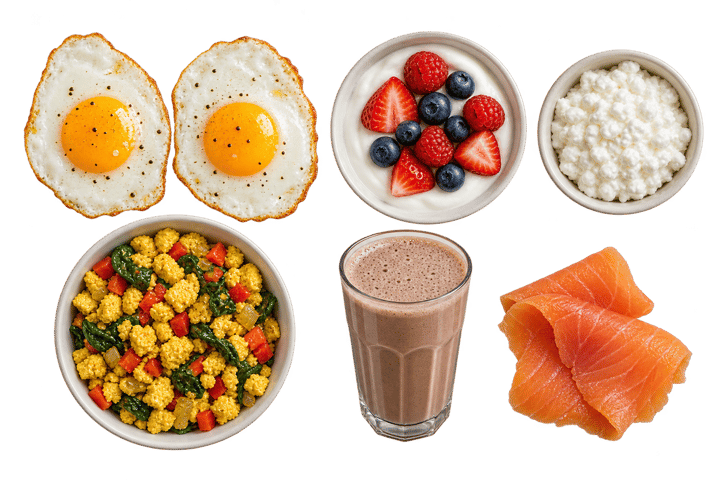
Our is my number enough? calculator does the same check for a plain gram figure, with the number shown as food. And if the number you heard was about pregnancy, building muscle or a GLP-1, those have their own pages: pregnancy, building muscle and GLP-1.
8 sources
- US Department of Agriculture and US Department of Health and Human Services, Dietary Guidelines for Americans, 2025 to 2030, January 2026cdn.realfood.gov
- US Food and Drug Administration, Daily Value on the Nutrition and Supplement Facts labelsfda.gov
- National Academies, Dietary Reference Intakes: Recommended Dietary Allowances and Adequate Intakes, total water and macronutrientsnationalacademies.org
- Morton et al., A systematic review, meta-analysis and meta-regression of the effect of protein supplementation on resistance training-induced gains in muscle mass and strength in healthy adults, British Journal of Sports Medicine, 2018pmc.ncbi.nlm.nih.gov
- Moore et al., Protein ingestion to stimulate myofibrillar protein synthesis requires greater relative protein intakes in healthy older versus younger men, Journals of Gerontology Series A, 2015pubmed.ncbi.nlm.nih.gov
- Mozaffarian et al., Nutritional priorities to support GLP-1 therapy for obesity: a joint advisory, Obesity Pillars, 2025pmc.ncbi.nlm.nih.gov
- Devries et al., Changes in kidney function do not differ between healthy adults consuming higher- compared with lower- or normal-protein diets: a systematic review and meta-analysis, Journal of Nutrition, 2018pubmed.ncbi.nlm.nih.gov
- USDA National Agricultural Library, Food and Nutrition Information Center, calories per gram of proteinnal.usda.gov