How to eat more protein
On this page
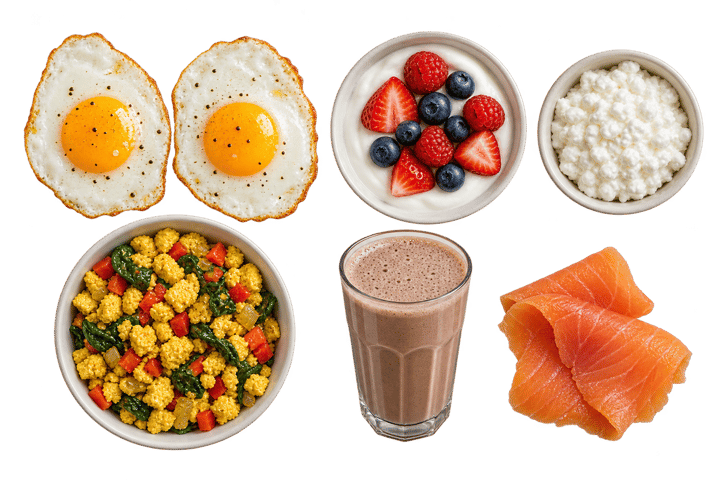
Build every meal around one food that carries a lot of protein for its calories, like shrimp, tuna, chicken breast, Greek yogurt, cottage cheese or tofu. Make a few swaps where your meals run low, usually breakfast, and use a shake when it helps. A day of 100 g fits in under 800 calories of real food.
What we’d do
Judge a food by its protein per 100 calories, and ignore the “high protein” claim on the box. Pick three or four foods from the top of the list below that you like, keep them in the fridge, and put one in every meal. Fix breakfast first. Use protein powder for the days you’re short, and build the plan on food. And photograph your meals for a couple of weeks before you change anything, so you know which meal is the one to fix.
If you remember three things
- Rank foods by protein per 100 calories. Shrimp has 24 g, chicken breast 20, peanut butter under 4.
- Weigh meat raw or cooked, and use the matching number. 4 oz raw is about 3 oz cooked, and both have about 25 g.
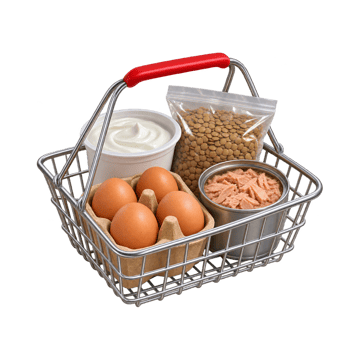
- Cheap protein exists. 25 g costs about 43 cents from dried beans and 77 cents from eggs.
Why “high protein” on the label doesn’t tell you much
A food can be high in protein and still be a poor way to get it. Peanut butter, nuts, quinoa and many protein bars carry real protein, but they carry a lot more fat or starch with it. Gyroscope’s first Protein Guide warned that many foods sold as healthy or high protein don’t contribute much, and the numbers bear that out.
The test that sorts them is simple. Divide the protein by the calories. A food with 20 g of protein per 100 calories lets you hit your range easily. A food with 4 g per 100 calories would take 2,500 calories to give you 100 g.
Foods ranked by protein per 100 calories
| Food | Serving | Protein | Calories | Protein per 100 calories |
|---|---|---|---|---|
| Shrimp, cooked | 3 oz | 20 g | 84 | 24.2 g |
| Canned light tuna in water | 3 oz | 17 g | 73 | 22.6 g |
| Whey protein powder | 1 scoop | 25 g | 113 | 22.2 g |
| Turkey breast, roasted | 3 oz | 25 g | 116 | 21.7 g |
| Cod, cooked | 3 oz | 19 g | 89 | 21.7 g |
| Egg whites | 1 large | 4 g | 17 | 21.0 g |
| Chicken breast, grilled | 3 oz | 26 g | 128 | 20.2 g |
| Pork tenderloin, roasted | 3 oz | 22 g | 122 | 18.3 g |
| Greek yogurt, plain nonfat | 5.3 oz cup | 15 g | 88 | 17.3 g |
| Cottage cheese, 1% | 1/2 cup | 14 g | 81 | 17.2 g |
| Top sirloin, lean | 3 oz | 25 g | 151 | 16.5 g |
| Ground beef 93/7, browned | 3 oz | 25 g | 178 | 13.8 g |
| Cottage cheese, 2% | 1/2 cup | 12 g | 92 | 12.8 g |
| Tofu, firm | 1/2 cup | 22 g | 181 | 12.0 g |
| Sardines in oil | 1 can | 23 g | 191 | 11.8 g |
| Salmon, farmed | 3 oz | 19 g | 175 | 10.7 g |
| Egg, whole | 1 large | 6 g | 72 | 8.8 g |
| Lentils, boiled | 1 cup | 18 g | 230 | 7.8 g |
| Milk, 2% | 1 cup | 8 g | 122 | 6.6 g |
| Cheddar | 1 oz | 7 g | 114 | 5.7 g |
| Bagel, plain | 1 medium | 11 g | 277 | 4.0 g |
| Peanut butter | 2 tbsp | 7 g | 191 | 3.7 g |
| White rice, cooked | 1 cup | 4 g | 205 | 2.1 g |
All from USDA FoodData Central. The per-calorie calculator has the full list of 49 foods with filters for plant, dairy and animal, and a Higher or Lower game built from these surprises.
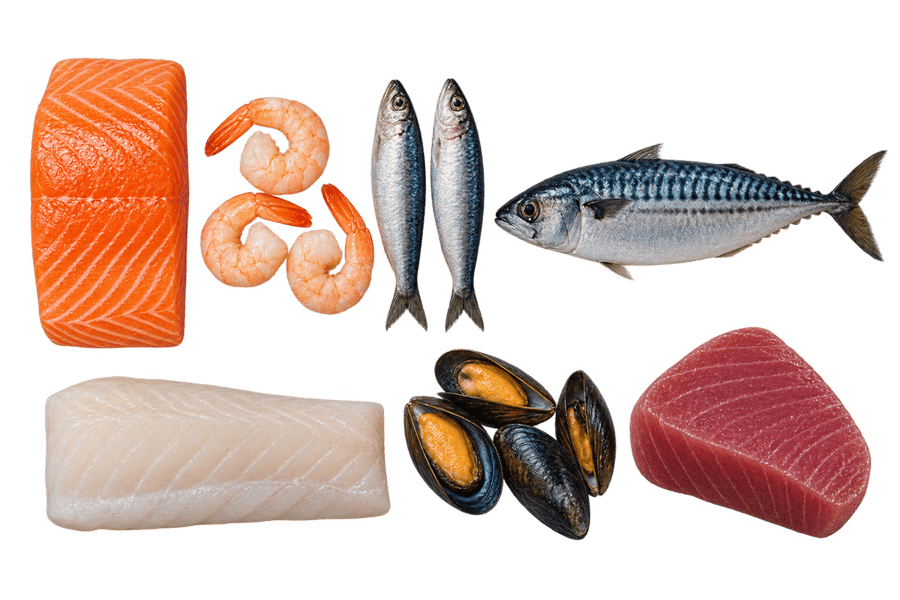
A few surprises hide in that table. Shrimp, canned tuna, turkey, cod and egg whites all beat chicken breast per calorie. Farmed salmon has half the protein per calorie of cod. 1% cottage cheese has more protein than 2%, in USDA’s own records. And a plain bagel beats peanut butter.
The swaps that work
Small swaps add up faster than a new diet. These are the ones from Gyroscope’s first guide that still hold, with the grams.
| Instead of | Try | Protein |
|---|---|---|
| A plain bagel | A cup of 1% cottage cheese and two eggs | 11 g to 41 g |
| 6 oz of regular yogurt | A 5.3 oz cup of nonfat Greek yogurt | 6 g to 15 g |
| A side of white rice | A cup of black beans or lentils | 4 g to 15 g or 18 g |
| A peanut butter sandwich | A turkey sandwich, 3 oz of turkey | 15 g to 33 g |
| Two cups of spaghetti | One cup with 4 oz of grilled chicken | 14 g to 42 g |
| Half a cup of 2% cottage cheese | Half a cup of 1% | 12 g to 14 g |
| An ounce of almonds as a snack | Half a cup of 1% cottage cheese | 6 g to 14 g |
| Croutons on a salad | A hard-boiled egg | add 6 g |
The spaghetti swap is the one people like best. Half the pasta and a piece of chicken is fewer calories (367 against 392) and three times the protein.
Tips from the first guide that still hold
Order double protein. Restaurants tend to go light on the chicken, beef or tofu in a dish. Ask for double. It costs a little more, and it’s one of the easiest ways to add a lot.
Buy quick protein. Cooking meat takes time. Keep rotisserie chicken, canned tuna or sardines, cottage cheese, Greek yogurt and hard-boiled eggs around for the days you don’t cook.
Cook extra. When you do cook chicken, lean ground beef or turkey, make double and freeze portions.
Put powder in food. A scoop of whey stirred into oatmeal or Greek yogurt adds 25 g without a separate shake.
Raw or cooked?
Meat loses water when it cooks, and the protein stays. The same piece of chicken breast has about 22.5 g of protein per 100 g raw and about 30.5 g per 100 g once it’s grilled.
| Chicken breast | Weight | Protein |
|---|---|---|
| Raw | 4 oz (113 g) | about 25 g |
| Grilled, the same piece | about 3 oz (84 g) | about 25 g |
If you weigh it raw, use the raw number. If you weigh it cooked, use the cooked one. Mixing them up is an easy mistake to make. Use the raw figure on a cooked weight and you count about a quarter too little. Use the cooked figure on a raw weight and you count more than a third too much. The raw or cooked calculator does chicken breast, thigh and lean ground beef.
Protein powder is a tool
A gram of protein from a shake counts the same as a gram from food. A scoop of whey has about 25 g of protein in about 113 calories, which is enough to fix most breakfasts on its own.
Read the label before you buy. Protein content varies a lot by product. One USDA record called “whey isolate” turns out to be a sweetened product that’s only 58% protein, against 89% for a plain unflavored isolate. We’d pick a plain or lightly flavored whey or soy powder and check the grams per scoop.
What does 25 g of protein cost?
US average prices from the Bureau of Labor Statistics, October 2026, with protein from the USDA records:
| Food | Price | 25 g of protein | 100 g of protein |
|---|---|---|---|
| Dried beans | $1.68 a pound | 43 cents | $1.71 |
| Eggs, grade A large | $2.32 a dozen | 77 cents | $3.07 |
| Whole milk | $4.10 a gallon | 83 cents | $3.33 |
| Chicken breast, boneless | $4.10 a pound | $1.00 | $4.02 |
| Cheddar | $6.13 a pound | $1.47 | $5.89 |
Eggs give you protein for less than chicken breast, and dried beans for less than half of that. The cost calculator works it out for your own daily number.
What 100 g looks like
| Food | Protein | Calories |
|---|---|---|
| 3 large eggs | 19 g | 216 |
| A 5.3 oz cup of nonfat Greek yogurt | 15 g | 88 |
| 4 oz of grilled chicken breast | 35 g | 171 |
| A cup of cooked lentils | 18 g | 230 |
| Half a cup of 1% cottage cheese | 14 g | 81 |
| Total | 101 g | 786 |
That’s the low end of the range for a 180 lb adult in under 800 calories, with the rest of the day’s calories left for vegetables, fruit, grains and fat. The daily range calculator scales the same five foods to your own number.
The case for per serving
Ranking by calories favors lean foods, and that’s the right list if you’re watching calories. If you’re not, per serving tells you more. Sardines (23 g a can), firm tofu (22 g in half a cup) and lean steak (25 g in 3 oz) do the job as well as chicken, with more calories. A big bowl of lentils is 18 g a cup and cheap.
The goal is to reach your range with food you like. Per calorie is the tie-breaker when calories are tight.
meals.guide covers how to build a plate with protein on it.
5 sources
- USDA FoodData Central, SR Legacy records 175180, 173709, 171986, 173180, 174516, 171956, 172183, 171534, 171077, 168250, 170894, 171284, 173417, 172182, 174054, 174755, 172475, 175139, 175168, 171287, 172421, 171267, 173414, 174899, 174266, 168878, 172688, 173735, 169737, 170567, 171244, 173177 and branded records 2339095 and 2495506fdc.nal.usda.gov
- US Bureau of Labor Statistics, Average Price Data, US city average, October 2026, series APU0000714233, APU0000708111, APU0000709112, APU0000FF1101 and APU0000710212bls.gov
- USDA National Agricultural Library, Food and Nutrition Information Centernal.usda.gov
- US Department of Agriculture and US Department of Health and Human Services, Dietary Guidelines for Americans, 2025 to 2030, January 2026cdn.realfood.gov
- USDA Agricultural Research Service, What We Eat in America, NHANES August 2021 to August 2023, data tablesars.usda.gov