How to get enough protein without protein powder
On this page
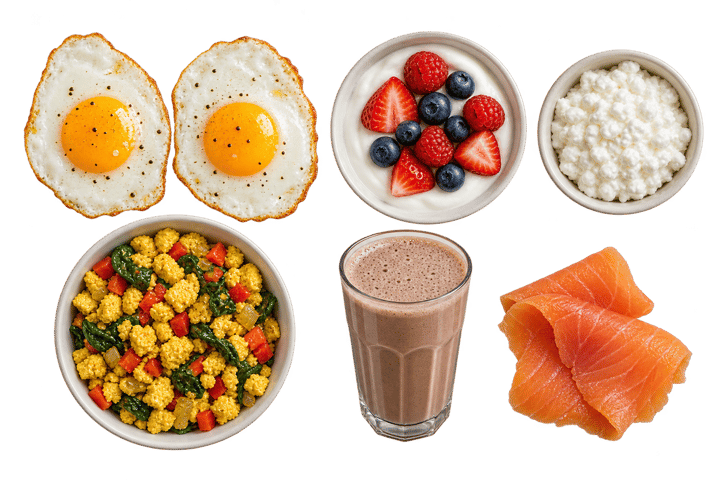
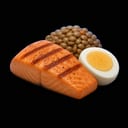
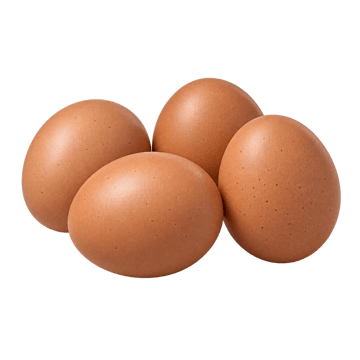
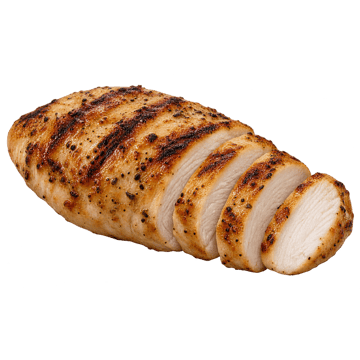
Put one protein food in every meal, starting with breakfast, and most adults reach their range with no powder at all. Eggs and Greek yogurt in the morning, a chicken sandwich at lunch, cottage cheese in the afternoon and salmon with lentils at night come to about 117 g of protein in under 1,100 calories. If you want to and if you can, get your protein from food first, and keep a scoop for the days food can’t do it.
What we’d do
Find your number in the daily range calculator. Pick three or four protein foods you like and keep them in the fridge, like eggs, Greek yogurt, cottage cheese, canned tuna, a rotisserie chicken, tofu or a pot of lentils. Put one in every meal, and fix breakfast first, since that’s where most people come up short. If you eat mostly plants, make one of them a bean, lentil or soy food at most meals. Keep protein powder for the meals you can’t fix with food. The Gyroscope app personalizes yours.
If you remember three things
- You don’t need powder. A gram of protein from food does the same job as a gram from a shake.
- One protein food per meal does most of it. The ordinary day below comes to 117 g with no scoop.
- Breakfast is the meal to fix. US adults average about 15 g there, half of a 30 g meal line.
Why it feels like you need a shake
Walk into a gym or down the protein aisle and powder looks like the normal way to get protein. Tubs, bars and shakes carry the word in big letters, and a target like 120 g a day sounds like more than a plate could hold. It’s easy to assume a shake is the only way to get there. Most people get there with food once every meal has one protein food in it.
The 2025 to 2030 US Dietary Guidelines open with the line “The message is simple: eat real food.” Their protein advice sits under the heading “Prioritize Protein Foods at Every Meal”, and it’s a list of foods: eggs, poultry, seafood and red meat, and beans, peas, lentils, nuts, seeds and soy. Protein powder doesn’t appear anywhere in it.
A scoop of powder is like a gift card for one shop. It’s real money, but it only buys protein. A meal pays in cash, with the protein and whatever else is on the plate, and the guidelines call dairy alone “an excellent source of protein, healthy fats, vitamins, and minerals”.
Your body can’t tell where the protein came from
Your gut breaks every protein into amino acids, the same building blocks whether they came from an egg, a chicken breast or a shake. In the biggest review of protein for people who lift, 49 trials with 1,863 people, protein supplements added muscle and strength by raising the day’s total, and the extra muscle leveled off near 1.6 g per kg a day. The shakes helped because they added grams, and food that adds the same grams gives the muscle the same amino acids.
A day of food, no scoop
This is an ordinary day for a 165 lb adult, whose typical range is 90 to 120 g a day and whose meal line is 30 g.
An everyday day
- Breakfast32 g
-
 Eggs2 large eggs 12.6 g
-
 Greek yogurt5.3 oz cup 15.3 g
-
 Whole wheat bread1 slice 4.0 g
-
- Lunch34 g
-
 Chicken breast3 oz cooked 25.9 g
- Whole wheat bread2 slices 8.0 g
-
- Snack14 g
-
 Cottage cheese, 1%1/2 cup 14.0 g
-
- Dinner37 g
-
 Salmon, farmed3 oz 18.8 g
-
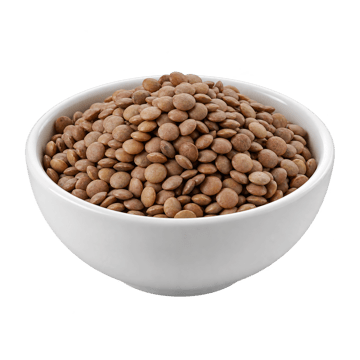
 Lentils1 cup 17.9 g
-
117 g of protein in about 1,090 calories, with a 30 g meal line
Each meal has one or two protein foods in it, with cottage cheese as the snack. Every meal clears the 30 g line, and the day ends inside the range with about 900 calories left for vegetables, fruit, grains and fat on a 2,000 calorie day.
The same idea works with no animal foods. It costs more calories, since plant protein comes packed with starch and fat.
A plant day
- Breakfast33 g
-
 Tofu1/2 cup 21.8 g
-
 Bagel, plain1 medium 11.1 g
-
- Lunch35 g
- Lentils1 cup 17.9 g
-
 Quinoa1 cup 8.1 g
-
 Pumpkin seeds1 oz 8.6 g
-
- Dinner37 g
-
 Tempeh3 oz 17.3 g
-
 Black beans1 cup 15.2 g
-
 White rice1 cup 4.3 g
-
104 g of protein in about 1,660 calories, with a 30 g meal line
That plant day lands at about 104 g, inside the range, with every meal over the line. Soy, lentils and beans do the heavy lifting, and the grains and seeds add a few grams each. The best plant-based protein sources, ranked has the rest of the list.
Four habits that replace the shake
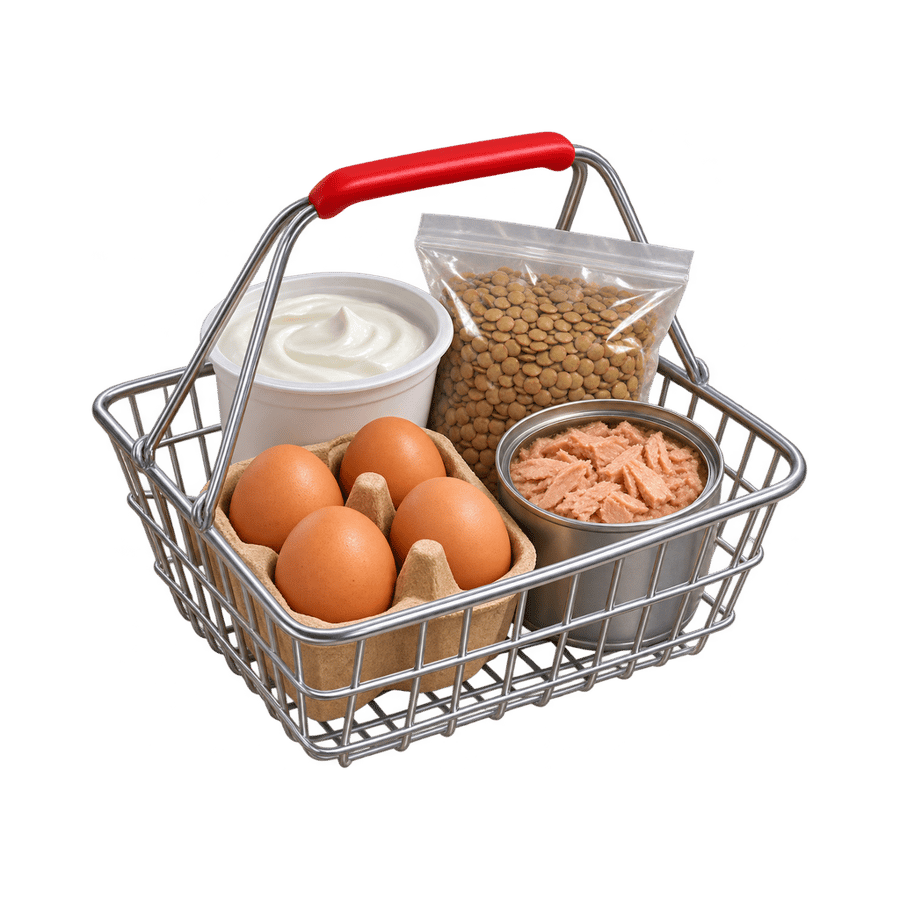
- One protein food in every meal. A meal built around eggs, Greek yogurt, fish, chicken, tofu or lentils usually lands at 25 g or more. A meal built around bread, pasta or cereal usually doesn’t.
- Fix breakfast first. In the latest national food survey (2021 to 2023), US adults ate about 15 g of protein at breakfast and 32 g at dinner. Two eggs and a cup of Greek yogurt bring breakfast to about 28 g.
- Keep quick protein ready. Rotisserie chicken, canned tuna, cottage cheese, Greek yogurt and hard-boiled eggs need no cooking, so a busy day doesn’t fall back on toast.
- Ask for double when you eat out. Double chicken, beef or tofu in a bowl or a salad is the quickest fix away from home.
If you eat mostly plants, put a bean, lentil or soy food in most meals, since those carry the lysine that grains and nuts run short on. The US guidelines ask vegetarians and vegans to “diversify plant protein sources for amino acid balance” and to limit highly processed vegan and vegetarian foods.
Food is the cheap way
At US average prices in October 2026, 25 g of protein costs about 43 cents from dried beans, 77 cents from eggs and a dollar from chicken breast. The cost calculator works it out for your own daily number.
When a scoop makes sense
Food first is the plan if you want to and if you can. Some days you can’t, and a shake is a fine tool for those:
- A small appetite on a GLP-1. The 2025 advisory from four US obesity and nutrition societies says some people “can meet protein targets by supplementing with high-protein shakes, bars, and other fortified products”.
- A very high target. Lean people lifting hard on a diet may aim for 2.3 to 3.1 g per kg of lean mass, from a 2014 review of six studies, and that’s a lot of chicken.
- Travel and long days, when the fridge is far away.
- A breakfast you can’t change, like coffee on the way out the door.
Then pick a plain whey or soy powder, check the grams per scoop, and keep it to the gaps. In Consumer Reports’ 2025 tests of 23 powders and shakes, more than two thirds had more lead in one serving than its cautious daily level, and CR advised against daily use for most of them. Protein powder: when it helps, which kind and how much covers the choice.
8 sources
- US Department of Agriculture and US Department of Health and Human Services, Dietary Guidelines for Americans, 2025 to 2030, January 2026cdn.realfood.gov
- USDA FoodData Central, SR Legacy records 171287, 170894, 172688, 171534, 173417, 175168, 172421, 172475, 174899, 168917, 170556, 174272, 173735 and 168878fdc.nal.usda.gov
- Morton et al., A systematic review, meta-analysis and meta-regression of the effect of protein supplementation on resistance training-induced gains in muscle mass and strength in healthy adults, British Journal of Sports Medicine, 2018pmc.ncbi.nlm.nih.gov
- USDA Agricultural Research Service, What We Eat in America, NHANES August 2021 to August 2023, data tablesars.usda.gov
- US Bureau of Labor Statistics, Average Price Data, US city average, October 2026, series APU0000714233, APU0000708111 and APU0000FF1101bls.gov
- Mozaffarian et al., Nutritional priorities to support GLP-1 therapy for obesity: a joint advisory from the American College of Lifestyle Medicine, the American Society for Nutrition, the Obesity Medicine Association and The Obesity Society, 2025pmc.ncbi.nlm.nih.gov
- Helms, Zinn, Rowlands and Brown, A systematic review of dietary protein during caloric restriction in resistance trained lean athletes: a case for higher intakes, International Journal of Sport Nutrition and Exercise Metabolism, 2014pubmed.ncbi.nlm.nih.gov
- Consumer Reports, Protein powders and shakes contain high levels of lead, October 14, 2025, updated January 8, 2026consumerreports.org