What does protein actually do?
On this page
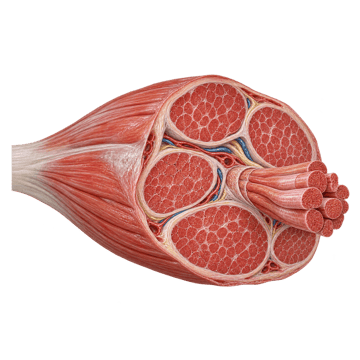
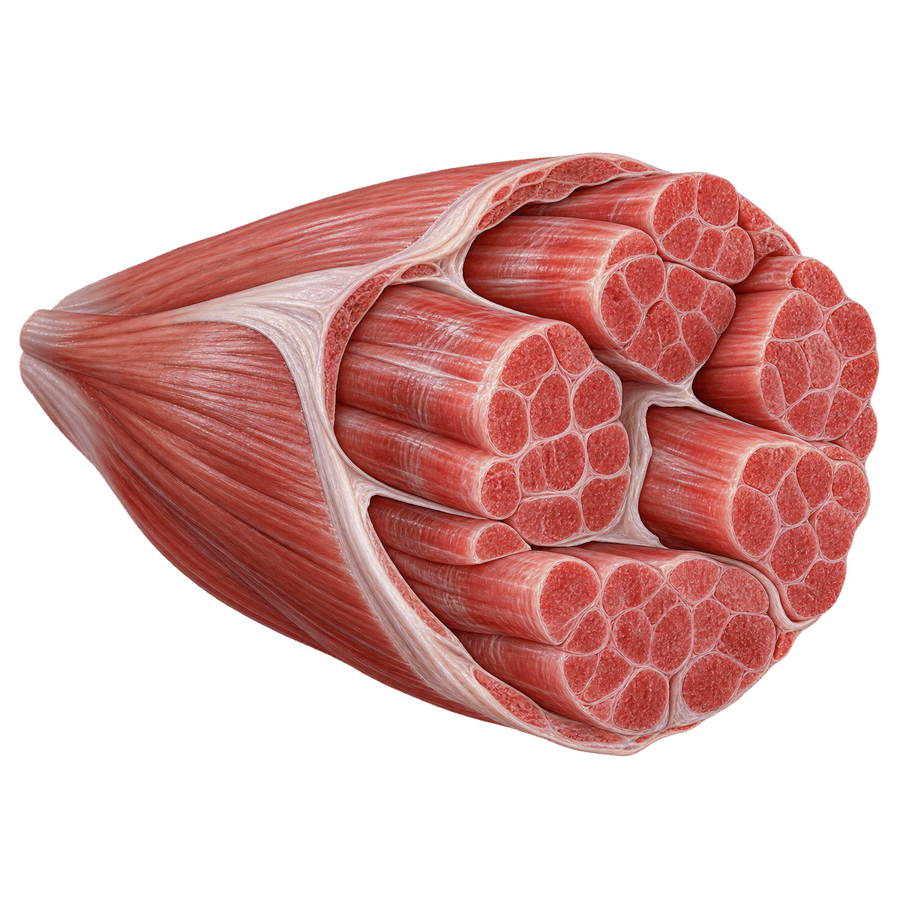
Protein is the raw material your body uses to rebuild itself. Your gut breaks it into amino acids, and your muscles use them to replace old protein with new, about 2% of it every day. Lifting tells the muscle to build more than it takes apart, and that’s how protein turns into muscle.
What we’d do
Treat protein as the daily supply and lifting as the reason to use it. Eat your daily range, make each meal big enough to clear your meal line, and lift at least two days a week. Get it from food you like. A gram from a shake counts the same as a gram from chicken, and nobody needs to track single amino acids if they eat a mix of protein foods.
If you remember three things
- Your muscle is rebuilt every day. About 2% of the protein in leg muscle is made new daily, at 25 and at 75.
- Protein supplies the parts. Amino acids from food are what the new muscle protein is built from.
- Lifting decides how much gets built. In one study the leg that worked built about 12% more each day than the leg that rested.
Why “eat protein, get muscle” is only half right
Most people picture protein as muscle in a tub. You eat it, and it becomes muscle. Others think protein is only for bodybuilders, and that the rest of us get plenty without trying.
Both pictures leave out the same thing. Your muscle is being taken apart and rebuilt all day, every day, whether you go to the gym or not. Protein is what the rebuilding is made from, so everybody needs it. And whether that rebuilding leaves you with more muscle, the same, or less depends mostly on how much protein comes in and whether the muscle is being asked to work.
The muscle that rebuilds itself
Researchers at the University of Exeter tested this with a neat trick in 2023. They had 16 young adults train one leg and rest the other for three days, while drinking a little heavy water (water with a harmless tag in it). Every new piece of muscle protein the body built picked up the tag, so they could count how much was made new.
The resting leg made about 2.2 to 2.4% of its muscle protein new each day. The working leg made about 12% more than that. Each person was their own comparison, same blood, same food, one leg asked to work and one not.
A Danish team got almost the same number in adults aged 65 to 80: about 2.2% a day. At that pace a muscle makes as much new protein as it holds in about seven weeks.
Think of it as a brick building that’s always under repair. Crews take out a few old bricks every day and put in new ones. Protein from food is the brick delivery. Lifting is the work order that tells the crews to put in more than they take out.
What are amino acids?
Protein is a long chain of smaller pieces called amino acids. When you eat it, your gut cuts the chain apart and the amino acids go into your blood. Your muscles, organs, skin and blood then link them back together in new orders to make the proteins they need.
Your body can make some amino acids itself. The others, called essential amino acids, have to come from food. Leucine, lysine and methionine are three of them.
Leucine gets the most attention because it helps switch on muscle building after a meal. Foods differ a lot in how much they carry. In a 2018 lab analysis of protein powders at Maastricht University:
| Protein | Leucine, share of the protein | Essential amino acids, share of the protein |
|---|---|---|
| Whey | 11% | 43% |
| Milk | 9% | 39% |
| Egg | 7% | 32% |
| Human muscle itself | 7.6% | 38% |
| Plant proteins, average of 10 kinds | 7.1% | 21 to 37% (oat 21, wheat 22, soy 27, pea 30, potato 37) |
Animal proteins carry more of the essential amino acids, which is why a plant protein often needs a bigger serving to do the same job. The plants section covers how much bigger.
What lifting adds
Protein keeps the rebuilding supplied, and lifting is what makes it add up to more muscle.
In a 2018 review of 49 lifting trials with 1,863 people, adding protein during programs of six weeks or more added about 0.3 kg (0.7 lb) of extra lean mass and about 2.5 kg (5.5 lb) on the one-rep max, on top of what the lifting did. The effect was bigger in people who already trained and smaller in older people. The extra muscle stopped growing once people ate about 1.6 g per kg a day.
A 2022 review of 74 trials found the same pattern. More protein gave a small extra gain in lean mass and in leg strength, and in adults under 65 who lifted, it showed up at 1.6 g per kg a day or more.
One leg works, one rests
16 young adults, 3 days, then 22 for 10 weeks. Monteyne and colleagues, University of Exeter, 2023
The trained leg built about 12% more new muscle protein each day than the resting leg. Over 10 weeks of lifting five days a week, lean mass rose by about 2.6 to 3.1 kg.
Young, healthy adults on a high-protein diet, so it shows what lifting adds when protein is already plenty.
49 lifting trials pooled
1,863 people. Morton and colleagues, British Journal of Sports Medicine, 2018
Extra protein added about 0.3 kg of lean mass and 2.5 kg of strength on top of lifting. Gains leveled off at about 1.6 g per kg a day.
The level-off point is uncertain, anywhere from about 1.0 to 2.2 g per kg.
74 trials, young and old
Nunes and colleagues, Journal of Cachexia, Sarcopenia and Muscle, 2022
More protein gave small extra lean mass and leg strength. Under 65 it showed at 1.6 g per kg or more with lifting, and at 65 and over at 1.2 to 1.59.
The top group was “1.6 or more”, so it can’t show whether gains keep rising past 1.6.
What happens to protein you don’t use?
The muscle takes what it needs, and the rest of the amino acids get broken down. The body burns them for energy, and the nitrogen in them leaves as urea in your urine. That’s one reason we’d pair protein with lifting, since without the work order more of the delivery goes to the furnace.
Burning protein isn’t free. Your body spends about 20 to 30% of protein’s calories just digesting and processing it, against 5 to 10% for carbs and 0 to 3% for fat. Protein has 4 calories per gram, so 100 g is 400 calories, and roughly 80 to 120 of those go into handling it.
After a hard workout, the muscle can use more than people thought. In a 2023 trial in the Netherlands, young men who drank 100 g of protein after training kept building muscle for more than 12 hours, and the extra protein barely raised how much was burned. There’s more on that in the 30 g myth.
Does protein help if you don’t lift?
Yes, and most for people who eat too little. A 2021 review of 105 studies with 5,402 people found that below about 1.3 g per kg a day, each extra 0.1 g per kg went with about 0.39 kg more lean mass. Above 1.3 the gain per step was a third of that, 0.12 kg. Most of that big first number came from trials without lifting.
There’s also a link with how well older people get around. In a US survey of 11,680 adults over 50, people who ate less than even 0.8 g per kg had more trouble with everyday physical tasks, and those over 70 had weaker grip. That kind of survey can’t prove protein caused it, but it fits everything above. The after 50 section has more.
Where the science is still arguing
Much of what’s known about protein and muscle comes from lab studies that measure how fast muscle builds new protein over a few hours. That’s a different thing from how much muscle a person has after six months.
The two don’t always agree. In 2014, a study of 8 adults found that spreading protein evenly over three meals made muscle build about 25% faster over 24 hours than piling it into dinner. In 2022, a trial of 24 adults aged 65 to 80 found no difference at all between the even and the skewed day. Both measured building rates, and neither ran long enough to measure muscle size. An even spread is a reasonable habit, but the evidence that it builds more muscle is still weak.
Try it on yourself
You can’t see muscle protein being rebuilt, but you can see the inputs. Count your protein on three normal days and check it against your range, then check whether you lift twice a week. The US activity guidelines ask for at least 2 days of muscle work a week. If both are in place, the rebuilding has what it needs.
13 sources
- Monteyne et al., Vegan and omnivorous high protein diets support comparable daily myofibrillar protein synthesis rates and skeletal muscle hypertrophy in young adults, Journal of Nutrition, 2023pmc.ncbi.nlm.nih.gov
- Justesen et al., Comparing even with skewed dietary protein distribution shows no difference in muscle protein synthesis or amino acid utilization in healthy older individuals, Nutrients, 2022pmc.ncbi.nlm.nih.gov
- Gorissen et al., Protein content and amino acid composition of commercially available plant-based protein isolates, Amino Acids, 2018pmc.ncbi.nlm.nih.gov
- Morton et al., A systematic review, meta-analysis and meta-regression of the effect of protein supplementation on resistance training-induced gains in muscle mass and strength in healthy adults, British Journal of Sports Medicine, 2018pmc.ncbi.nlm.nih.gov
- Nunes et al., Systematic review and meta-analysis of protein intake to support muscle mass and function in healthy adults, Journal of Cachexia, Sarcopenia and Muscle, 2022pmc.ncbi.nlm.nih.gov
- Tagawa et al., Dose-response relationship between protein intake and muscle mass increase: a systematic review and meta-analysis of randomized controlled trials, Nutrition Reviews, 2021pmc.ncbi.nlm.nih.gov
- Trommelen et al., The anabolic response to protein ingestion during recovery from exercise has no upper limit in magnitude and duration in vivo in humans, Cell Reports Medicine, 2023pmc.ncbi.nlm.nih.gov
- Schoenfeld and Aragon, How much protein can the body use in a single meal for muscle-building? Implications for daily protein distribution, Journal of the International Society of Sports Nutrition, 2018pmc.ncbi.nlm.nih.gov
- Westerterp, Diet induced thermogenesis, Nutrition and Metabolism, 2004pmc.ncbi.nlm.nih.gov
- Mamerow et al., Dietary protein distribution positively influences 24-h muscle protein synthesis in healthy adults, Journal of Nutrition, 2014pubmed.ncbi.nlm.nih.gov
- Krok-Schoen et al., Low dietary protein intakes and associated dietary patterns and functional limitations in an aging population: a NHANES analysis, Journal of Nutrition, Health and Aging, 2019pmc.ncbi.nlm.nih.gov
- USDA National Agricultural Library, Food and Nutrition Information Centernal.usda.gov
- CDC, Adult activity: an overview, 2023cdc.gov