Daily protein intake by age, goal and body size
On this page
Most adults need 1.2 to 1.6 g of protein per kg of body weight a day. That’s about 75 to 100 g at 140 lb, 100 to 130 g at 180 lb and 120 to 160 g at 220 lb. Under 1.2 is too low. Count from today’s weight, unless you have more than a fifth of it to lose.
What we’d do
Start at the low end of your range and make sure you reach it every day, since that’s where most of the benefit is. Move toward the top end if you lift hard, you’re losing weight, or you’re over 65. Don’t bother going past the top unless you’re lean and dieting while you lift, and then count it from your lean mass. Put your weight and goal in the daily range calculator to see yours in grams and as food. The Gyroscope app personalizes yours.
If you remember three things
- 0.8 g per kg is the floor. It’s the RDA, set to cover basic needs. The US guideline since January 2026 is 1.2 to 1.6.
- The lifting trials leveled off near 1.6 g per kg. That’s about 0.7 g per pound, below the gym’s gram per pound.
- Count from today’s weight, unless a lot is to lose. 250 lb aiming for 180 counts as 230 lb.
Why does 0.8 g per kg still show up everywhere?
The 0.8 g per kg number has been around a long time, and it’s still the recommended daily amount (RDA) in the National Academies’ tables. That’s 56 g a day for a man and 46 g for a woman at the reference weights. Many health sites, apps and articles still treat it as the target.
The RDA was set to cover the basic needs of nearly all healthy adults. The average need in those same tables is lower still, 0.66 g per kg. Both describe the amount that covers basic needs, and the newer research on muscle, dieting and age points higher.
The US Dietary Guidelines changed that in January 2026. They now set protein goals of “1.2–1.6 grams of protein per kilogram of body weight per day”, and say to put protein at every meal. The report behind them notes there’s no upper limit for protein, and that active people should aim for the top of the range, 1.4 to 1.6.
Most people still fall short. The report puts the average American adult at about 1 g per kg a day. In the latest national survey, adults ate about 77 g a day, and in an earlier analysis of the same survey, up to 46% of adults over 70 ate less than even 0.8.
The three ranges
These are the same three zones bodyfat.guide and tdee.guide use, so the same person gets the same grams on all three.
- 65 g 0.8 g per kg, the RDA, the old minimum
- 130 g 1.6 g per kg, where gains leveled off in 49 lifting trials
- 180 g 2.2 g per kg, the top of that study's uncertainty
Many people are here.
The bar is for a 180 lb adult. The marker is the average American adult’s day, 77 g, in the low zone for anyone this size.
| Your weight | Too low | Typical | Per meal, 3 meals | The old RDA |
|---|---|---|---|---|
| 120 lb (54 kg) | under 65 g | 65 to 85 g | 20 to 30 g | 44 g |
| 140 lb (64 kg) | under 75 g | 75 to 100 g | 25 to 35 g | 51 g |
| 160 lb (73 kg) | under 85 g | 85 to 115 g | 30 to 40 g | 58 g |
| 180 lb (82 kg) | under 100 g | 100 to 130 g | 35 to 45 g | 65 g |
| 200 lb (91 kg) | under 110 g | 110 to 145 g | 35 to 50 g | 73 g |
| 220 lb (100 kg) | under 120 g | 120 to 160 g | 40 to 55 g | 80 g |
| 250 lb, goal 180 | under 125 g | 125 to 165 g | 40 to 55 g | 91 g |
The Gyroscope app personalizes yours. These ranges are here to show you if you’re too low, and many people are.
The third zone is for lean people who lift hard while they diet: 2.3 to 3.1 g per kg of lean mass, from a review of 6 studies of trained lifters cutting. At 180 lb and 15% bodyfat that’s about 160 to 215 g. It’s counted from lean mass because fat tissue barely needs protein. The losing weight section explains when it applies.
Which weight should you count from?
Today’s weight, unless you have more than a fifth of it to lose. Then count from your goal plus a fifth of today’s weight.
A person at 250 lb aiming for 180 has 70 lb to lose, more than a fifth of 250. Their base is 180 plus 50, which is 230 lb, so their range is 125 to 165 g instead of 135 to 180. A person at 200 lb aiming for 170 has less than a fifth to lose, so they count from 200.
Here’s why. A protein range counted from total weight treats every pound the same, and a pound of fat needs almost none. At 300 lb, 1.6 g per kg of total weight is about 220 g, more than many lifters eat. Counting from the goal alone goes too far the other way, since the body you have today still has to be fed and kept. The goal plus a fifth sits in between, and it never jumps when you move your goal by a few pounds.
Protein intake by age
The US reference intakes, the RDAs, change with age until 19 and then stay flat for life. They’re floors that cover basic needs, set by the National Academies in 2005.
| Age | RDA a day | At the reference weights |
|---|---|---|
| 4 to 13 | 0.95 g per kg | 19 g at 4 to 8, 34 g at 9 to 13 |
| 14 to 18 | 0.85 g per kg | 52 g for boys, 46 g for girls |
| 19 and over | 0.8 g per kg | 56 g for men, 46 g for women |
| Pregnancy, second half | 1.1 g per kg | 71 g |
| Breastfeeding | 1.3 g per kg | 71 g |
For adults, the typical range of 1.2 to 1.6 g per kg holds at every age. Age changes the meal more than the day. In pooled lab studies, muscle building after one meal leveled off at about 0.24 g per kg in men around 22 and 0.40 in men around 71, so older muscle needs a bigger meal. After 65, the PROT-AGE expert group asks for at least 1.0 to 1.2 g per kg a day. The after 50 section has the details.
Under 18, the ranges and calculators on this site don’t apply, since they’re built for adults. Teens grow on the RDA in the table, and a pediatrician is the person to ask about more. Who sets their own number has the resources for teens and parents.
What the lifting trials say
If you lift, you’ve heard 1 g per pound. That’s 2.2 g per kg, and it’s more than most people need.
In 2018, researchers at McMaster University pooled 49 lifting trials with 1,863 people. Extra protein added muscle, but the gains stopped rising at about 1.62 g per kg a day. The uncertainty around that point was wide, from 1.03 to 2.20, so the authors suggested about 2.2 for people trying to build all the muscle they can.
The gram per pound matches the top end of that uncertainty. For most people who lift, 1.6 g per kg (about 0.7 g per pound) is where the trials stopped finding more muscle. A 2022 review of 74 trials agrees that lifters under 65 gained more at 1.6 or above, but its top group was “1.6 or more”, so it can’t say whether more helps past 1.6.
Lean lifters on a diet are the one group where higher numbers have a clear case. The 1 g per pound myth goes through it.
Is the new guideline right?
Some nutrition scientists think the guideline overreached. In a 2026 commentary in the Journal of Nutrition, six researchers wrote that the range rests on a quick review of trials focused on weight loss, and gives too little attention to protein and long-term disease, from heart disease to kidney disease and cancer.
They have a point about the evidence. Most of the trials behind 1.2 to 1.6 were in adults losing weight. But the range lines up with the other evidence too. Lifters stopped gaining past about 1.6. Experts in older adults ask for at least 1.0 to 1.2 after 65. And the kidney trials in healthy adults found no harm at these amounts.
We think the range is right as a typical range, with the low end as the number to reach. Going higher is mostly about calories and cost, which is why the is my number enough? calculator shows both.
Why per kg and not percent of calories?
The National Academies also give protein as a share of calories, 10 to 35%. That band is so wide it barely helps. At 1,500 calories, 10% is about 38 g. At 3,000 calories, 35% is about 260 g.
Your muscle doesn’t know how many calories you ate. It knows how much of it there is to feed, which is why the range follows body weight. On a diet the share goes up on its own, since the grams stay put while the calories drop. 100 g of protein is 400 calories, about a quarter of a 1,500 calorie day.
What your number looks like as food
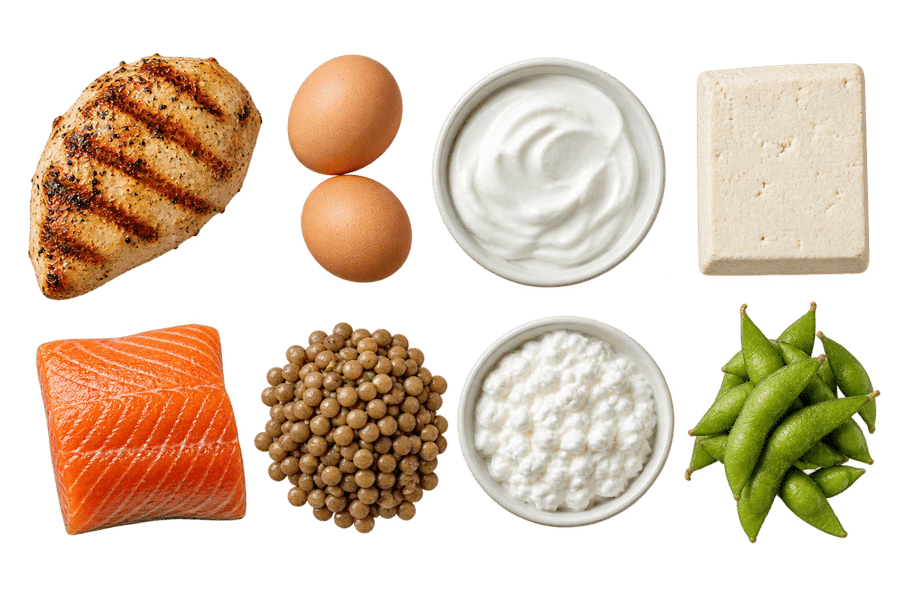
A range in grams is hard to picture. The low end at 180 lb, about 100 g, is three large eggs, a 5.3 oz cup of nonfat Greek yogurt, 4 oz of grilled chicken breast, a cup of cooked lentils and half a cup of 1% cottage cheese. That’s about 101 g of protein in about 790 calories.
150 g is about four 4 oz cooked chicken breasts and a Greek yogurt. If that sounds like a lot of chicken, it’s because 150 g is more than most people need. It’s typical for someone between about 205 and 275 lb.
15 sources
- US Department of Agriculture and US Department of Health and Human Services, Dietary Guidelines for Americans, 2025 to 2030, January 2026cdn.realfood.gov
- Scientific Foundation for the Dietary Guidelines for Americans, 2025 to 2030cdn.realfood.gov
- National Academies, Dietary Reference Intakes: Recommended Dietary Allowances and Adequate Intakes, total water and macronutrientsnationalacademies.org
- Health Canada, Dietary Reference Intakes tables, reference values for macronutrients (Institute of Medicine, 2005)canada.ca
- Pasiakos et al., Perspectives on the protein recommendations in the 2025-2030 Dietary Guidelines for Americans, Journal of Nutrition, 2026pubmed.ncbi.nlm.nih.gov
- Morton et al., A systematic review, meta-analysis and meta-regression of the effect of protein supplementation on resistance training-induced gains in muscle mass and strength in healthy adults, British Journal of Sports Medicine, 2018pmc.ncbi.nlm.nih.gov
- Nunes et al., Systematic review and meta-analysis of protein intake to support muscle mass and function in healthy adults, Journal of Cachexia, Sarcopenia and Muscle, 2022pmc.ncbi.nlm.nih.gov
- Bauer et al., Evidence-based recommendations for optimal dietary protein intake in older people: a position paper from the PROT-AGE Study Group, Journal of the American Medical Directors Association, 2013pubmed.ncbi.nlm.nih.gov
- Devries et al., Changes in kidney function do not differ between healthy adults consuming higher- compared with lower- or normal-protein diets: a systematic review and meta-analysis, Journal of Nutrition, 2018pubmed.ncbi.nlm.nih.gov
- Helms, Zinn, Rowlands and Brown, A systematic review of dietary protein during caloric restriction in resistance trained lean athletes: a case for higher intakes, International Journal of Sport Nutrition and Exercise Metabolism, 2014pubmed.ncbi.nlm.nih.gov
- USDA Agricultural Research Service, What We Eat in America, NHANES August 2021 to August 2023, data tablesars.usda.gov
- Krok-Schoen et al., Low dietary protein intakes and associated dietary patterns and functional limitations in an aging population: a NHANES analysis, Journal of Nutrition, Health and Aging, 2019pmc.ncbi.nlm.nih.gov
- USDA National Agricultural Library, Food and Nutrition Information Centernal.usda.gov
- USDA FoodData Central, SR Legacy records 170894 and 171534fdc.nal.usda.gov
- Moore et al., Protein ingestion to stimulate myofibrillar protein synthesis requires greater relative protein intakes in healthy older versus younger men, Journals of Gerontology Series A, 2015pubmed.ncbi.nlm.nih.gov