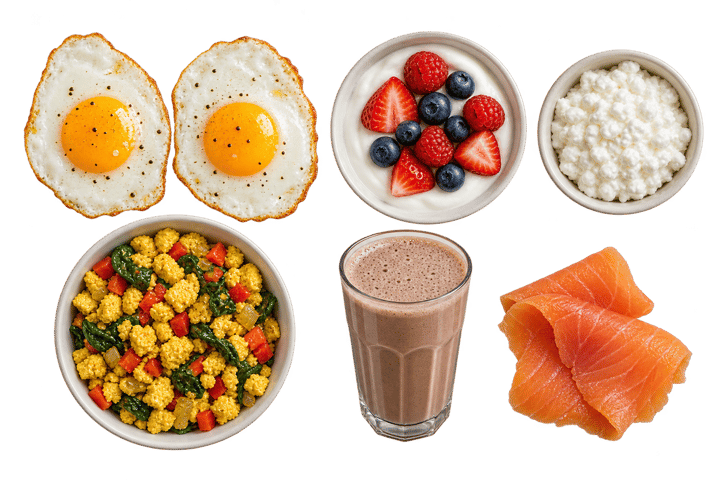
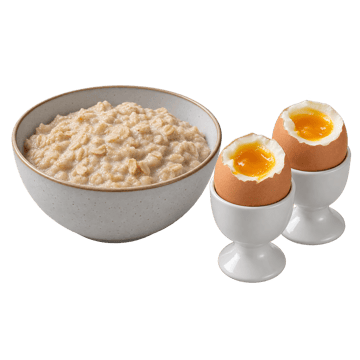
How much protein per meal, and does breakfast matter?
On this page
Aim for about 0.4 g of protein per kg of body weight at each meal. That’s about 25 g at 140 lb, 30 g at 160 lb and 35 g at 180 lb. American adults eat about 15 g at breakfast and 32 g at dinner, so breakfast is the meal to fix first.
What we’d do
Make breakfast, lunch and dinner each clear your meal line, starting with breakfast. Don’t worry about making the meals equal beyond that, and let a big dinner be a big dinner, since protein past your line isn’t wasted. If your day is short, breakfast is the cheapest place to add the grams. A Greek yogurt next to two eggs and toast takes a 17 g breakfast to 32 g.
If you remember three things
- Your meal line is about 0.4 g per kg. At 180 lb that’s about 35 g, the same at every age.
- Breakfast is where most people fall short. About 15 g on average, against 32 g at dinner.
- Going over at a meal is fine. In a 2023 trial, 100 g at once kept muscle building for more than 12 hours.
Two rules that sound like they disagree
You may have heard both of these. Your body can only use about 30 g of protein at a time, so anything more is wasted. And only the daily total counts, so it doesn’t matter when you eat it.
Neither is right, and each holds a piece of the truth. A meal does need to be big enough to get muscle building going, which is why a 10 g breakfast does little for your muscle. But there’s no hard ceiling above that, and the order of your meals counts for much less than whether each one is big enough.
The American day
In the national food survey for 2021 to 2023, American adults got 19% of their protein at breakfast, 27% at lunch, 42% at dinner and 13% from snacks. Out of about 77 g a day, that’s about 15 g at breakfast, 21 g at lunch, 32 g at dinner and 10 g in snacks.
For a 160 lb adult the meal line is 30 g. Only the average dinner gets there.
Two eggs and toast
For a 160 lb adult, against the US average breakfast

 17 g
Add a Greek yogurt
The same breakfast with a 5.3 oz cup of nonfat Greek yogurt
 32 g
Breakfast is low for a simple reason. The usual breakfast foods, like bagels, cereal, toast and oatmeal, are mostly starch. A plain bagel has 11 g of protein in 277 calories. Lunch and dinner are built around a piece of meat, fish, beans or tofu, and breakfast often isn’t built around anything.
Where the meal line comes from
In 2015, researchers in Canada, the UK and the US pooled their lab studies of men who drank 0 to 40 g of protein and had their muscle building measured. In men around 22, muscle building leveled off at about 0.24 g per kg of body weight. In men around 71, it took about 0.40 g per kg to get there.
A second paper from the same group took the younger men’s number, 0.25, and added two standard deviations to cover people who need more than average. That came out at 0.4 g per kg. A 2018 review landed on the same 0.4 g per kg a meal, over at least four meals.
The meal line on this site is 0.4 g per kg at every age. It’s the older men’s average and the safe estimate for young adults, so nobody has to guess where they fall between 22 and 71.
| Your weight | Your meal line |
|---|---|
| 120 lb (54 kg) | 20 g |
| 140 lb (64 kg) | 25 g |
| 160 lb (73 kg) | 30 g |
| 180 lb (82 kg) | 35 g |
| 220 lb (100 kg) | 40 g |
| 250 lb (113 kg) | 45 g |
If you have more than a fifth of your weight to lose, the line counts from the same base weight as your daily range. The Gyroscope app personalizes yours.
Is protein past the line wasted?
No. The 30 g ceiling came from short lab studies that watched muscle for a few hours. In 2023, a team in Maastricht gave 36 young men 0, 25 or 100 g of milk protein after a full-body workout and measured them for 12 hours. The 100 g gave about 20% more muscle building in the first four hours and about 40% more from hours four to twelve, and it was still going at the end.
That was one meal after a workout, in young men. It’s still good news for people who eat most of their protein at dinner, or who eat in a short window. A big dinner does more than a small one. The 30 g myth has the whole story.
Does spreading protein evenly help?
Plenty of advice says to spread protein evenly, but the studies behind it are small.
Four 20 g doses won
24 trained young men, 12 hours after a workout. Areta and colleagues, RMIT University, 2013
80 g of whey as four 20 g doses built 31 to 48% more muscle protein than eight 10 g doses or two 40 g doses.
One workout, 12 hours, and it measured building rates, not muscle size.
Even beat skewed
8 adults, 7 days each way. Mamerow and colleagues, 2014
About 30 g at each of three meals built 25% more muscle protein over 24 hours than 11 g, 16 g and 63 g.
Only 8 people, and building rates only.
No difference
24 adults aged 65 to 80. Justesen and colleagues, Copenhagen, 2022
An even spread over three meals and a day skewed to dinner built muscle protein at the same rate, 2.16 and 2.23% a day.
Small and short, but it asked the same question in the people it should help most.
The three studies say very small doses do less, and that a few medium meals beat lots of tiny ones. They don’t show that perfectly equal meals build more muscle over months. That’s why the meal line is a minimum for each meal, and going over is fine.
Then why start with breakfast?
Breakfast is where the grams are missing, and where they’re easiest to add. Most people’s dinner already clears their line. Moving 15 g from a big dinner to breakfast changes the day’s shape. Adding 15 g at breakfast changes the day’s total, and that’s the number most people are short on.
| Breakfast | Protein | Calories |
|---|---|---|
| A plain bagel | 11 g | 277 |
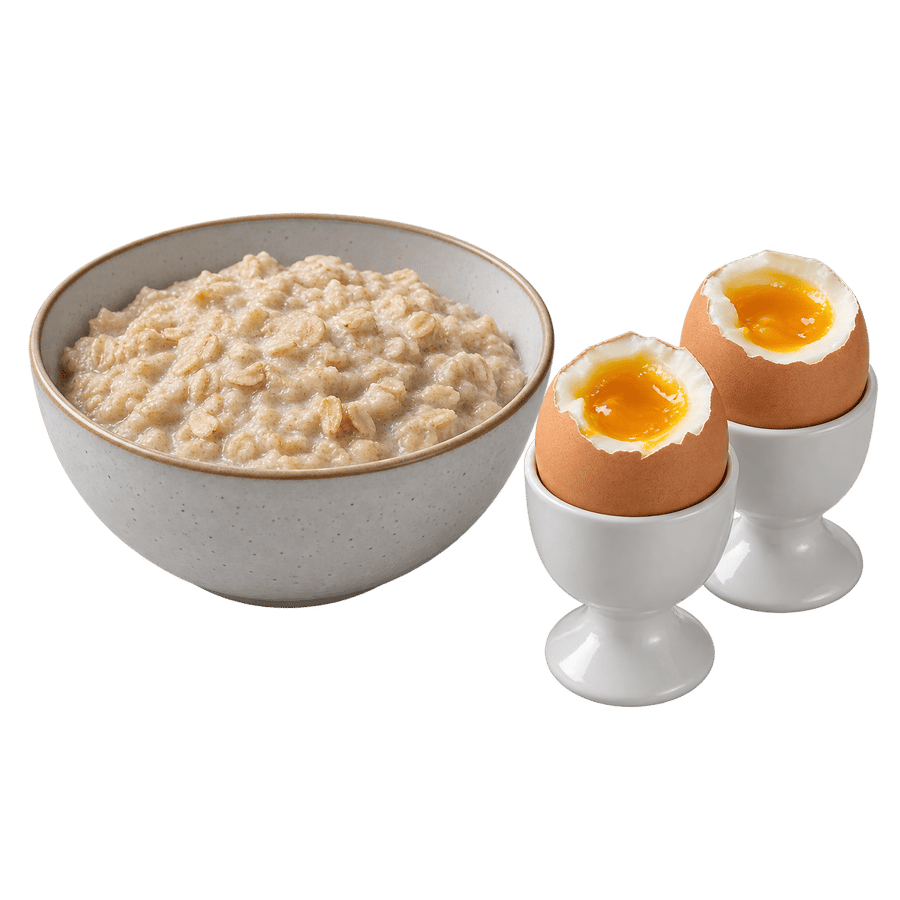
| Oatmeal with a cup of 2% milk | 13 g | 275 |
| A 5.3 oz cup of nonfat Greek yogurt | 15 g | 88 |
| Two large eggs and a slice of whole wheat toast | 17 g | 225 |
| A Greek yogurt and two eggs | 28 g | 232 |
| A Greek yogurt, two eggs and a slice of toast | 32 g | 313 |
| A scoop of whey in a cup of 2% milk | 33 g | 235 |
| Oatmeal with milk and a scoop of whey stirred in | 38 g | 388 |
| A cup of 1% cottage cheese and two eggs | 41 g | 307 |
The yogurt and two eggs have fewer calories than the bagel and two and a half times the protein.
Breakfast trials point the same way, with a limit. In a 12-week trial, 57 young adults who usually skipped breakfast ate a 35 g protein breakfast, a 13 g breakfast, or kept skipping. The 35 g group gained no fat and ate less over the day than the skippers. But against the 13 g breakfast, the 35 g one made no measurable difference. What we can say is that a protein breakfast beats skipping, and that breakfast is the easiest place to raise the day.
The case that only the day counts
Some researchers argue the daily total is all that counts, and they have good evidence for one part of it. In a 2013 review of 23 studies, the timing of protein around workouts made no difference to muscle growth once the day’s total was counted, and the day’s total was the strongest predictor of growth.
We agree the day comes first. If you reach your range, you’ve done most of it. The meal line makes the biggest difference at the low end, where a 10 or 15 g breakfast barely gets muscle building started, and for older adults, whose muscle needs a bigger meal to respond. The after 50 section covers that.
Check your own meals
Build your usual breakfast in the meal line calculator and see whether it clears your line, then try one swap. The quiz does the same for all three meals and tells you which one to fix first.
meals.guide covers the plate side of the same idea: protein on every plate.
12 sources
- USDA Agricultural Research Service, What We Eat in America, NHANES August 2021 to August 2023, data tablesars.usda.gov
- Moore et al., Protein ingestion to stimulate myofibrillar protein synthesis requires greater relative protein intakes in healthy older versus younger men, Journals of Gerontology Series A, 2015pubmed.ncbi.nlm.nih.gov
- Morton, McGlory and Phillips, Nutritional interventions to augment resistance training-induced skeletal muscle hypertrophy, Frontiers in Physiology, 2015pmc.ncbi.nlm.nih.gov
- Schoenfeld and Aragon, How much protein can the body use in a single meal for muscle-building? Implications for daily protein distribution, Journal of the International Society of Sports Nutrition, 2018pmc.ncbi.nlm.nih.gov
- Areta et al., Timing and distribution of protein ingestion during prolonged recovery from resistance exercise alters myofibrillar protein synthesis, Journal of Physiology, 2013pmc.ncbi.nlm.nih.gov
- Trommelen et al., The anabolic response to protein ingestion during recovery from exercise has no upper limit in magnitude and duration in vivo in humans, Cell Reports Medicine, 2023pmc.ncbi.nlm.nih.gov
- Mamerow et al., Dietary protein distribution positively influences 24-h muscle protein synthesis in healthy adults, Journal of Nutrition, 2014pubmed.ncbi.nlm.nih.gov
- Justesen et al., Comparing even with skewed dietary protein distribution shows no difference in muscle protein synthesis or amino acid utilization in healthy older individuals, Nutrients, 2022pmc.ncbi.nlm.nih.gov
- Schoenfeld, Aragon and Krieger, The effect of protein timing on muscle strength and hypertrophy: a meta-analysis, Journal of the International Society of Sports Nutrition, 2013pmc.ncbi.nlm.nih.gov
- Leidy et al., a 12-week randomized trial of higher-protein and normal-protein breakfasts in breakfast-skipping adolescents, Obesity, 2015pubmed.ncbi.nlm.nih.gov
- US Department of Agriculture and US Department of Health and Human Services, Dietary Guidelines for Americans, 2025 to 2030, January 2026cdn.realfood.gov
- USDA FoodData Central, SR Legacy records 170894, 171287, 172688, 173180, 171267, 173417, 173904 and 174899fdc.nal.usda.gov