Your body can only use 30 g of protein at a meal
Short answerNo
On this page
No. The 30 g idea came from short lab studies of muscle building, and none of them measured how much protein you absorb. In a 2023 trial, 100 g of protein after a workout kept muscle building going for more than 12 hours, longer and stronger than 25 g. A big protein meal isn’t wasted.
What we’d do
Treat your meal line as the minimum for each meal, about 0.4 g per kg, and stop worrying about a ceiling. If dinner is a 6 oz steak with 50 g of protein, enjoy it. For most people the meal to fix is the 15 g breakfast, so put your effort there.
If you remember three things
- The 30 g limit was about muscle building over a few hours. It never measured how much protein you absorb.
- 100 g beat 25 g. More muscle building, and it lasted more than 12 hours.
- Each meal still needs enough. A meal that’s too small does less, which is why the meal line exists.
Why people believe it
“Your body can only absorb 30 g at a time” is a line you’ll hear in any gym. It has real studies behind it, in a way. Lab studies gave young men different doses of protein after a workout and measured how fast their muscle built new protein over the next few hours. The response seemed to top out at about 20 to 25 g of a good protein, and the rest was thought to be burned for energy.
That’s a finding about muscle building rate, over a few hours, in young men, usually after a fast-digesting shake. Somewhere between the lab and the gym, it turned into a rule about absorption, and then into a rule that extra protein is wasted.
A cow, a drip and 36 young men
To follow protein from a glass into a muscle, you need to tag it. In 2023, a team at Maastricht University gave a Holstein cow a 96-hour drip of tagged amino acids, so the protein in her milk came out carrying a chemical tag. They turned that milk into protein drinks.
Then 36 young men did a full-body workout and drank 0, 25 or 100 g of the tagged milk protein. The researchers took blood and muscle samples for 12 hours and followed the tagged protein into the blood and then into the muscle.
The more protein the men drank, the more of it showed up in their blood and in their muscle. The 100 g dose gave about 20% more muscle building than 25 g in the first four hours, and about 40% more from hours four to twelve. It was still going at the end. The extra protein barely raised the amount burned for energy. The authors titled the paper “The anabolic response to protein ingestion during recovery from exercise has no upper limit in magnitude and duration”.
The old studies stopped watching after a few hours, long before a big dose was used up.
A simpler way to picture it
Think of a big grocery delivery. If you can only put away 30 items an hour, a 100 item delivery doesn’t mean 70 items get thrown out. They sit on the counter and get put away over the next few hours. The old studies watched the first hour and counted only what made it into the cupboard.
What the studies found
0, 25 or 100 g after a full-body workout
36 young men aged 18 to 40, 12 per group. Trommelen and colleagues, Maastricht, 2023
100 g gave more muscle building than 25 g, about 20% more in hours 0 to 4 and about 40% more in hours 4 to 12, with negligible extra protein burned.
One meal after a workout, men only, and it measured building rate, not muscle gained over months.
Per meal, for building muscle
A 2018 review. Schoenfeld and Aragon
Bigger doses do burn more amino acids, but not all the extra is lost, and some goes into building tissue. They suggested 0.4 g per kg a meal over at least four meals, and up to 0.55 g per kg.
Written for people who lift and want to build muscle.
Older muscle needs a bigger meal
Pooled lab data. Moore and colleagues, 2015
Muscle building leveled off at about 0.24 g per kg of body weight in men around 22, and about 0.40 in men around 71. At 165 lb, that’s 18 g against 30 g.
Men only, with doses up to 40 g.
Where the 30 g idea has a point
There’s a fair version of the claim. In a 2013 study in Melbourne, 24 trained young men had 80 g of whey over 12 hours after a workout. Four doses of 20 g built more muscle protein than either eight doses of 10 g or two doses of 40 g, by 31 to 48%. Spacing protein out can do better than lumping it, at least over those 12 hours.
All three patterns raised muscle building well above resting, by 88 to 148%, so the 40 g doses still did a lot. And in 2022, a trial in 24 adults aged 65 to 80 found an even spread over three meals and a day skewed to dinner built muscle at the same rate. If your day already has enough protein, a big dinner is fine. If your day is short, the fix is to add a meal with enough in it, usually breakfast.
The American day, again
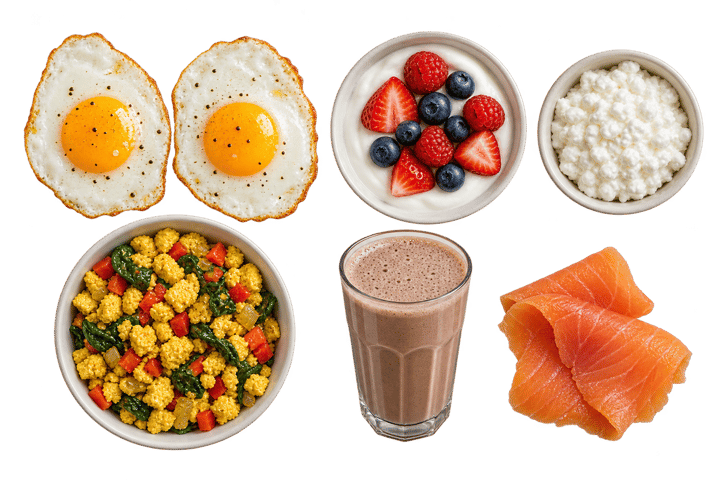
American adults eat about 15 g of protein at breakfast and about 32 g at dinner, on average. The 30 g myth makes people think the dinner is the problem. For most people, the dinner is the one meal that works, and the breakfast is the one that’s missing.
meals.guide covers the same belief from the plate’s side: your body can only use 30 g of protein at a meal.
More detail: absorbed against used for muscle
Absorption and muscle building are two different steps. Your gut breaks protein into amino acids and moves them into the blood. The 2023 trial showed this directly. The bigger the dose, the more protein-derived amino acids appeared in the blood. What the muscle does with those amino acids is the second step, and that’s what the early studies measured over a few hours. Some amino acids get burned for energy, some go into other proteins in the body, and some go into muscle. A bigger dose takes longer to work through all of that.
7 sources
- Trommelen et al., The anabolic response to protein ingestion during recovery from exercise has no upper limit in magnitude and duration in vivo in humans, Cell Reports Medicine, 2023pmc.ncbi.nlm.nih.gov
- Moore et al., Protein ingestion to stimulate myofibrillar protein synthesis requires greater relative protein intakes in healthy older versus younger men, Journals of Gerontology Series A, 2015pubmed.ncbi.nlm.nih.gov
- Schoenfeld and Aragon, How much protein can the body use in a single meal for muscle-building? Implications for daily protein distribution, Journal of the International Society of Sports Nutrition, 2018pmc.ncbi.nlm.nih.gov
- Areta et al., Timing and distribution of protein ingestion during prolonged recovery from resistance exercise alters myofibrillar protein synthesis, Journal of Physiology, 2013pmc.ncbi.nlm.nih.gov
- Justesen et al., Comparing even with skewed dietary protein distribution shows no difference in muscle protein synthesis or amino acid utilization in healthy older individuals, Nutrients, 2022pmc.ncbi.nlm.nih.gov
- USDA Agricultural Research Service, What We Eat in America, NHANES August 2021 to August 2023, data tablesars.usda.gov
- USDA FoodData Central, SR Legacy records 174054 and 171534fdc.nal.usda.gov