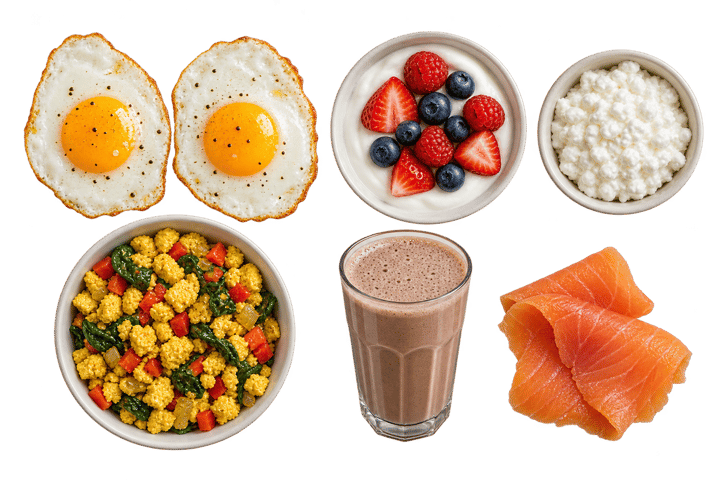
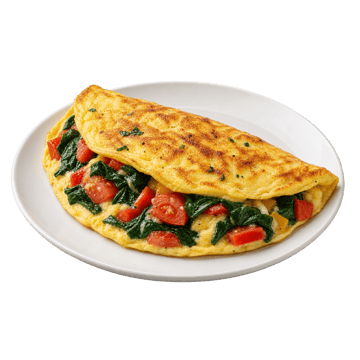
How much protein should I eat at breakfast?
On this page
Aim for your meal line, about 0.4 g of protein per kg of body weight. For most adults that’s 25 to 35 g. American adults average about 15 g at breakfast and about 32 g at dinner, so breakfast is the meal that runs lowest, and the easiest one to fix. Check yours in the meal line calculator. The Gyroscope app personalizes yours.
Breakfast in America is built on carbs. A bagel, a bowl of cereal, toast, a muffin, or just coffee on the way out. None of that feels like a protein problem, and by dinner most people eat a big portion of meat or fish, so the day seems to even out. It doesn’t, quite. The national food survey for 2021 to 2023 found US adults get 19% of their day’s protein at breakfast and 42% at dinner.
We’d fix breakfast first, and we’d do it for a practical reason. It’s the emptiest meal, it’s the one you eat at home, and the same breakfast tends to repeat every day, so one swap pays off 365 times a year. We don’t think breakfast has magic timing. A 2022 trial in adults aged 65 to 80 found no difference in muscle building between an even day and a dinner-heavy one. Breakfast is just where the missing grams are easiest to find.
Most people’s protein day looks like rush hour traffic. There’s almost nothing on the road at 8 am and everyone’s out at once at 7 pm.
Your breakfast against your line
| Breakfast | Protein | Calories | Clears a 30 g line? |
|---|---|---|---|
| Just coffee | 0 g | 2 | no |
| A plain bagel | 11 g | 277 | no |
| 1/2 cup oats with a cup of 2% milk | 13 g | 275 | no |
| A 5.3 oz nonfat Greek yogurt | 15 g | 88 | no |
| 2 large eggs and a slice of whole wheat toast | 17 g | 225 | no |
| A Greek yogurt and 2 eggs | 28 g | 232 | almost |
| A scoop of whey with a cup of 2% milk | 33 g | 235 | yes |
| A cup of 1% cottage cheese and 2 eggs | 41 g | 306 | yes |
The surprise is the bagel. A Greek yogurt and two eggs have more than twice its protein and fewer calories (USDA). Build your own in the meal line calculator, which starts with these as presets.
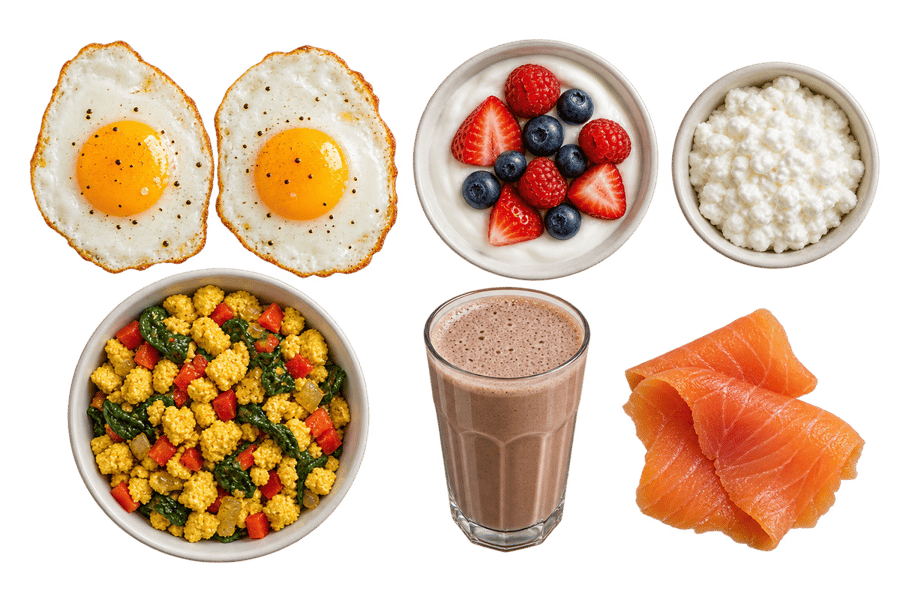
Why older people need a bigger breakfast
In 2015, Daniel Moore and colleagues pooled lab studies of how much protein one meal takes to get muscle building to its peak. Men around 22 leveled off at about 0.24 g per kg. Men around 71 needed about 0.40. For a 165 lb person, that’s about 18 g against 30 g. Three eggs (19 g) do the job at 22. At 70 it takes something like a Greek yogurt, two eggs and a slice of whole wheat toast (32 g). See protein after 50.
Does a protein breakfast help with hunger?
Against no breakfast, yes, in one well-known trial. Heather Leidy and colleagues gave 57 overweight 19-year-olds who usually skipped breakfast either a 35 g protein breakfast, a normal 13 g breakfast, or nothing, for 12 weeks. The 35 g group ate less over the rest of the day and didn’t gain fat, while the skippers gained about 3.5 lb (1.6 kg). But the 35 g breakfast didn’t beat the normal 13 g one in a direct comparison. A big protein breakfast beats skipping, and against a normal breakfast the case is weaker.
Three swaps that clear the line
- Bagel to a Greek yogurt and two eggs: 11 g to 28 g, and 45 fewer calories.
- Cereal or oatmeal to a cup of 1% cottage cheese and two eggs: about 13 g to 41 g.
- Coffee only to a whey shake made with milk: 0 g to 33 g, and you can drink it in the car.
The quiz finds the swap that clears your line from the breakfast you actually eat. meals.guide has the plate side of the same fix.
5 sources
- USDA Agricultural Research Service, What We Eat in America, NHANES August 2021 to August 2023, Tables 1, 13, 21 and 25ars.usda.gov
- Moore et al., Protein ingestion to stimulate myofibrillar protein synthesis requires greater relative protein intakes in healthy older versus younger men, Journals of Gerontology Series A, 2015pubmed.ncbi.nlm.nih.gov
- Justesen et al., Comparing even with skewed dietary protein distribution shows no difference in muscle protein synthesis in healthy older individuals, Nutrients, 2022pmc.ncbi.nlm.nih.gov
- Leidy et al., high-protein breakfast trial in overweight breakfast-skipping 19-year-olds, Obesity, 2015pubmed.ncbi.nlm.nih.gov
- USDA FoodData Central, SR Legacy records 174899 (bagel), 173904 (oats), 171267 (2% milk), 170894 (nonfat Greek yogurt), 171287 (egg), 172688 (whole wheat bread), 173180 (whey) and 173417 (1% cottage cheese)fdc.nal.usda.gov