The best plant-based protein sources, ranked
On this page
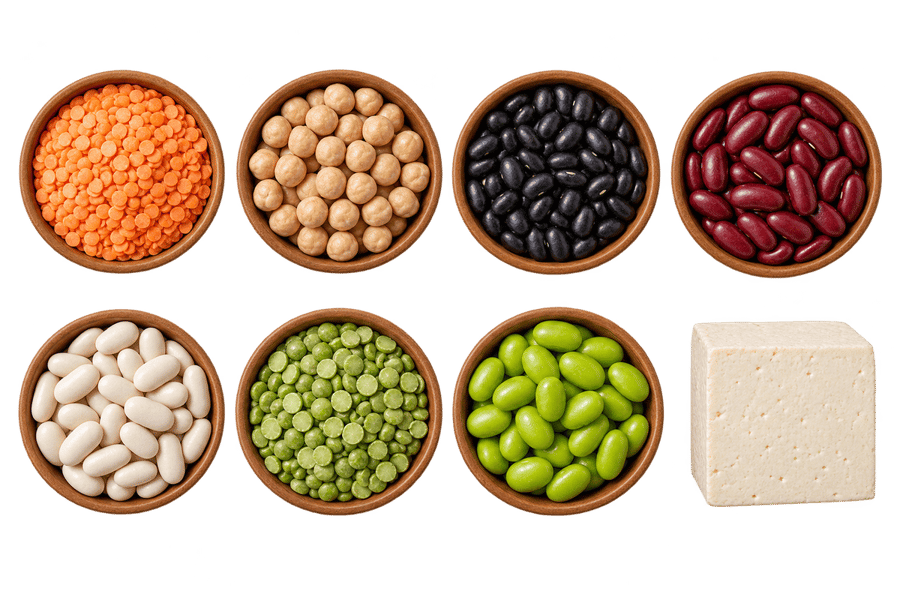
Soy and seitan lead, then lentils and beans. Per 100 calories, seitan has 16.7 g of protein, firm tofu 12.0, tempeh 10.6, edamame 9.8 and lentils 7.8. Per serving, half a cup of tofu has about 22 g, and a cup of edamame, lentils or black beans has 15 to 18. Nuts, seeds, quinoa and grains carry real protein too, but much less for their calories, so we’d count them as sides.
What we’d do
Build each meal around one of the dense ones: tofu, tempeh, edamame, seitan, lentils or beans. Use soy as your main protein where you can, since it carries every essential amino acid in the amounts adults need. Add nuts, seeds and whole grains for a few more grams, and keep a bean, lentil or soy food in most meals so lysine is covered. Find your number in the daily range calculator. The Gyroscope app personalizes yours.
If you remember three things
- Soy, seitan, lentils and beans do the work. Each gives about 15 g or more in a normal serving.
- Quinoa, peanut butter and almonds have 3.7 g per 100 calories. A plain bagel has 4.0.
- Grains and nuts run short on lysine. Beans, lentils and soy fill it.
Why plant protein lists mislead
Most lists of plant protein rank foods per 100 g, which puts hemp seeds (about 32 g), pumpkin seeds (30 g) and peanut butter (22 g) at the top. But 100 g of pumpkin seeds is 559 calories, and nobody eats 100 g of peanut butter at lunch. Quinoa gets called a protein food because it carries every essential amino acid, and it does. It also has 8 g of protein in a cooked cup at 222 calories, less than a cup of black beans has in about the same calories.
Think of tofu, tempeh, seitan, lentils and beans as the main course, and nuts, seeds and grains as the side dishes. Sides add up, but a plate of sides rarely reaches 30 g.
Ranked by protein per 100 calories
This is the list for anyone watching calories, and plant eaters feel it most, since plant protein comes packed with starch and fat.
- Seitan strips15 g in 2 oz 16.7 g
-
 Tofu, firm21.8 g in 1/2 cup 12.0 g
-
 Tempeh17.3 g in 3 oz 10.6 g
-
 Edamame, shelled18.4 g in 1 cup 9.8 g
-
 Lentils17.9 g in 1 cup 7.8 g
-
 Black beans15.2 g in 1 cup 6.7 g
-
 Pumpkin seeds8.6 g in 1 oz 5.4 g
-
 Chickpeas14.5 g in 1 cup 5.4 g
-
 Whole wheat bread4 g in 1 slice 4.9 g
-
 Bagel, plain11.1 g in 1 medium 4.0 g
-
 Peanut butter7.1 g in 2 tbsp 3.7 g
-
 Spaghetti7.2 g in 1 cup 3.7 g
-
 Quinoa8.1 g in 1 cup 3.7 g
-
 Almonds6 g in 1 oz 3.7 g
-
 Oats, dry5.3 g in 1/2 cup 3.5 g
-
 White rice4.3 g in 1 cup 2.1 g
Seitan is the leanest plant protein by a distance, since it’s made from wheat gluten, the protein part of wheat. Tofu comes next. USDA has two firm tofu records, at 17.3 and 9.04 g per 100 g, and both work out at about 12 g per 100 calories, so a brand’s label can differ from the table by a lot.
Ranked by protein per serving
| Food | Serving | Protein | Calories |
|---|---|---|---|
| Tofu, firm | 1/2 cup | 21.8 g | 181 |
| Edamame, shelled | 1 cup | 18.4 g | 188 |
| Lentils, boiled | 1 cup | 17.9 g | 230 |
| Tempeh | 3 oz | 17.3 g | 163 |
| Black beans, boiled | 1 cup | 15.2 g | 227 |
| Seitan strips | 2 oz | 15 g | 90 |
| Chickpeas, boiled | 1 cup | 14.5 g | 269 |
| Bagel, plain | 1 medium | 11.1 g | 277 |
| Pumpkin seeds | 1 oz | 8.6 g | 158 |
| Quinoa, cooked | 1 cup | 8.1 g | 222 |
| Spaghetti, cooked | 1 cup | 7.2 g | 196 |
| Peanut butter | 2 tbsp | 7.1 g | 191 |
| Almonds | 1 oz | 6.0 g | 164 |
| Oats, dry | 1/2 cup | 5.3 g | 153 |
| White rice, cooked | 1 cup | 4.3 g | 205 |
| Whole wheat bread | 1 slice | 4.0 g | 81 |
| Hummus | 2 tbsp | 2.3 g | 71 |
USDA FoodData Central, one record per food. Seitan is a branded record, so check your own pack.
The top seven all clear about 15 g in a normal serving, and one of them in a meal with a grain or a slice of bread gets most adults close to a 25 to 30 g meal line. A cup of lentils and a cup of quinoa together come to 26 g.
Ranked by quality: does it carry every essential amino acid?
Every plant food has all nine essential amino acids. What differs is how much of each, against what adults need. This chart sets each food’s lowest one against the adult pattern from FAO.
- Chia seedsmeets the pattern
100% - Black beansmeets the pattern
100% - Soy (tofu, tempeh, edamame)meets the pattern
100% - Hummusmeets the pattern
100% - Chickpeasmeets the pattern
100% - Oatsmeets the pattern
100% - Quinoameets the pattern
100% - Lentilsshort on methionine and cysteine
98% - Pumpkin seedsshort on lysine
91% - Hemp seedsshort on lysine
90% - Brown riceshort on lysine
80% - White riceshort on lysine
80% - Peanutsshort on lysine
77% - Peanut buttershort on lysine
68% - Whole wheatshort on lysine
60% - Almondsshort on lysine
60% - Pastashort on lysine
50%
Soy, black beans and chickpeas meet the pattern in USDA’s numbers, and lentils come within 2%. Quinoa, oats and chia meet it too, though they carry little protein per serving. Pumpkin seeds, hemp, rice, peanuts, peanut butter, almonds, whole wheat and pasta all run short on the same one, lysine. Seitan has no amino acid row in USDA’s data, but it’s wheat protein, and in Stefan Gorissen’s 2018 analysis of protein isolates, wheat had the least lysine of any, 1.4% of its protein.
Digestion adds one more step. On DIAAS, the newer score that counts how much of each amino acid gets digested, a 2020 review by Lieke Herreman and colleagues rated soy high quality and pea, oat, hemp, wheat, rice and corn below that.
The fix for lysine is a bean
Beans, lentils and soy carry plenty of lysine, so pairing them with grains fills the gap. Rice and beans really do complete each other, and the plant combos tool shows how little bean a bowl of rice needs. Peanut butter on whole wheat doesn’t, since both run short on lysine.
The 2025 to 2030 US guidelines list “beans, peas, lentils, legumes, nuts, seeds, and soy” as plant protein foods and ask vegetarians and vegans to “diversify plant protein sources for amino acid balance”. That happens over a day of meals as well as on one plate.
The cheapest protein is a plant
Dried beans cost $1.68 a pound at US average prices in October 2026, which makes 25 g of protein about 43 cents. That’s the cheapest protein in the Bureau of Labor Statistics list, ahead of eggs at 77 cents. See the cheapest protein.
Can plants build muscle?
Yes, with a little more planning. Plant protein has less leucine, the amino acid most tied to switching on muscle building, about 7.1% of its protein against 11.0% for whey in Gorissen’s analysis. Soy, a pea and rice blend, or a bit more protein closes most of it. The trials are in can plants build muscle?, and the day-to-day plans in vegan and vegetarian.
6 sources
- USDA FoodData Central, SR Legacy records 172475, 174272, 168411, 172421, 173735, 173757, 170556, 174266, 170567, 168917, 173904, 172688, 174899, 169737, 168878, 174289 and 170148 (hemp seeds), and branded record 2495506 (seitan), with amino acid rows pulled from the FDC API on November 15, 2026fdc.nal.usda.gov
- FAO, Dietary protein quality evaluation in human nutrition, FAO Food and Nutrition Paper 92, 2013fao.org
- Gorissen et al., Protein content and amino acid composition of commercially available plant-based protein isolates, Amino Acids, 2018pmc.ncbi.nlm.nih.gov
- Herreman, Nommensen, Pennings and Laus, Comprehensive overview of the quality of plant- and animal-sourced proteins based on the digestible indispensable amino acid score, Food Science and Nutrition, 2020pmc.ncbi.nlm.nih.gov
- US Department of Agriculture and US Department of Health and Human Services, Dietary Guidelines for Americans, 2025 to 2030, January 2026cdn.realfood.gov
- US Bureau of Labor Statistics, Average Price Data, US city average, October 2026, series APU0000714233bls.gov