
Why do you need more protein after 50?
On this page
After 50 you need at least the typical 1.2 to 1.6 g of protein per kg a day, and each meal needs to be bigger than it did at 25. In lab studies, men around 71 needed about 0.40 g per kg at one meal for the full muscle response, against 0.24 for men around 22. Make breakfast clear the line first.
What we’d do
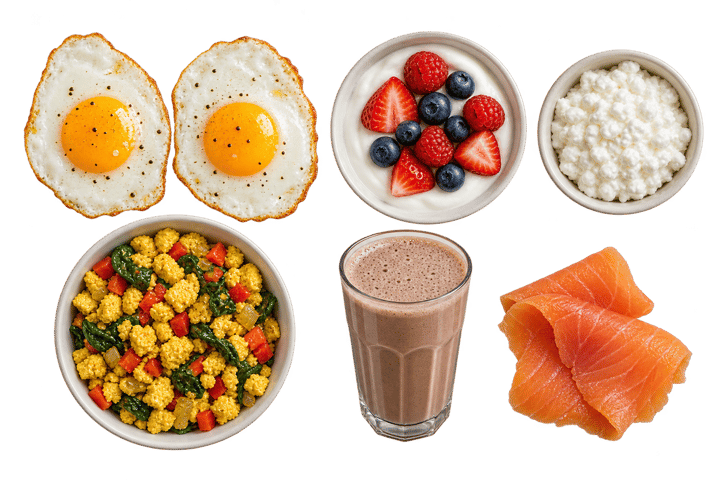
Eat your daily range, and make every meal reach your meal line, about 30 g at 165 lb. Start with breakfast, since that’s the meal most likely to fall short. Three eggs did the job at 22, and at 70 it takes a Greek yogurt, two eggs and a slice of toast. Lift at least twice a week, because older muscle needs the push more than young muscle does. If you have kidney disease, your doctor sets your number.
If you remember three things
- Older muscle needs a bigger meal. About 0.40 g per kg at 71, against 0.24 at 22.
- Many older adults eat too little. Up to 46% of US adults over 70 ate less than even the old 0.8 minimum.
- Lifting is the other half. Protein does less for older muscle on its own.
Why people think they need less
It makes sense on the surface. You’re smaller than you were, you move less, and you’re not hungry the way you were at 20. Lots of older people eat less of everything, and they assume protein should come down with it. The official RDA doesn’t help, since it’s the same 0.8 g per kg at 70 as at 30.
Older muscle works differently. More of the protein you eat gets used by the gut and the liver before it reaches the muscle, and the muscle answers less strongly to what does arrive. An expert group on protein in older adults (PROT-AGE) listed both of these as reasons older people need more protein.
Older muscle needs a bigger meal
In 2015, a group of researchers in Canada, the UK and the US pooled their lab studies in which men drank between 0 and 40 g of protein, then had their muscle building measured. They split the men by age. In men around 22, muscle building leveled off at about 0.24 g per kg of body weight. In men around 71, it took about 0.40 g per kg to get there, and the curve rose more slowly on the way.
For a 165 lb person, that’s about 18 g at 22 and about 30 g at 71.
Three eggs
19 g. Past where muscle building leveled off at 22, short of the line at 71
 19 g
Greek yogurt, two eggs and toast
32 g. Clears the line at every age

 32 g
The same breakfast that did the job at 22 falls short at 71. That’s why the meal line counts for more with age, and not only the day’s total. The line on this site is 0.4 g per kg at every age, so a 70 year old and a 30 year old at 165 lb get the same 30 g, and the younger one has some room to spare.
How much a day after 65?
| Who said it | What they suggest |
|---|---|
| US Dietary Guidelines, 2025 to 2030 | 1.2 to 1.6 g per kg a day for adults |
| PROT-AGE expert group, 2013 | At least 1.0 to 1.2 g per kg a day over 65. 1.2 or more if you exercise. 1.2 to 1.5 with an acute or long-term illness |
| ESPEN geriatrics guideline, 2019 | At least 1 g per kg a day |
| The RDA | 0.8 g per kg a day, the same at every adult age |
We’d use the same typical range as everyone, 1.2 to 1.6 g per kg, since the low end matches what the geriatric experts call the minimum. At 150 lb that’s about 80 to 110 g a day.
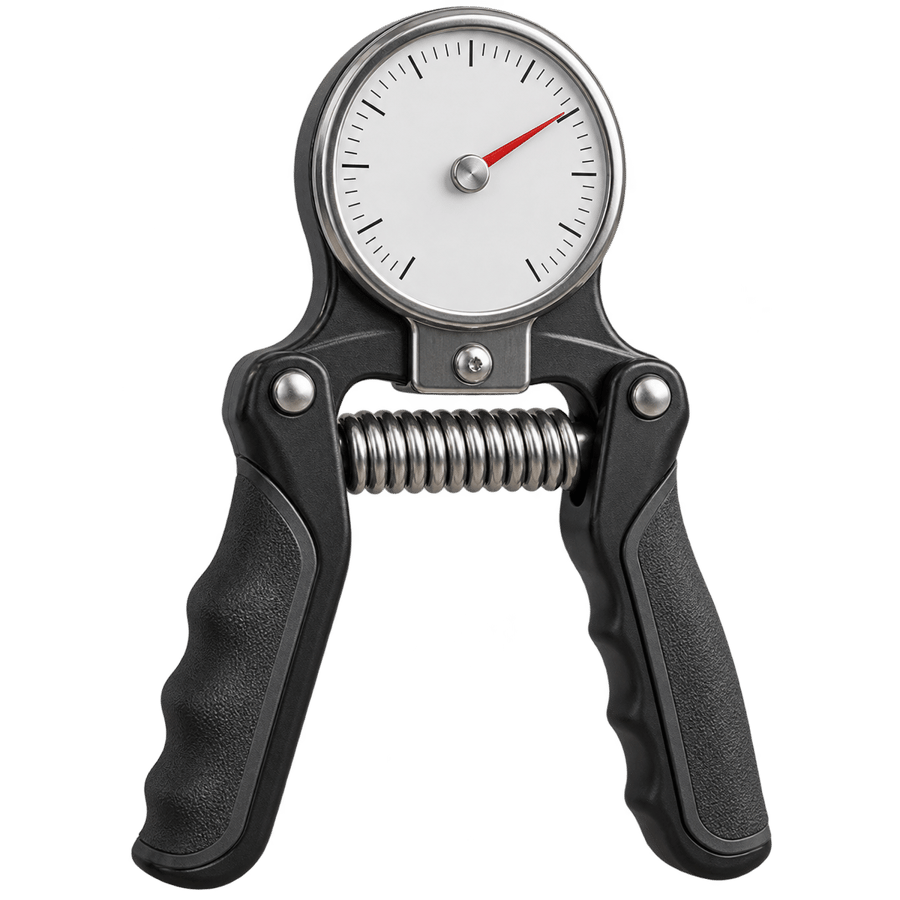
Many older adults are nowhere near it. In a US survey of 11,680 adults over 50, protein intake fell with each age group, and up to 46% of those 71 and older ate less than 0.8 g per kg. The people below it also had more trouble with everyday physical tasks, and those over 70 had weaker grip. A survey can’t prove the protein caused that, but it points the same way as the lab studies.
Lifting counts for more with age
Protein feeds the muscle, and lifting tells it to keep what it has. With age the second part counts for more.
In the 2018 review of 49 lifting trials, extra protein added muscle on top of lifting, but the effect got smaller with age. In a 2022 review of 74 trials, adults 65 and over who lifted gained extra lean mass at 1.2 to 1.59 g per kg a day. Older adults need both the protein and the lifting, and the protein alone does less.
The US activity guidelines ask every adult for at least 2 days of muscle work a week, at any age. lifespan.guide has a five-minute floor test, getting up off the floor without your hands, and a page on why it isn’t too late after 50.
Breakfasts that clear 30 g
For a 165 lb adult the meal line is 30 g.
| Breakfast | Protein | Clears 30 g? |
|---|---|---|
| A plain bagel | 11 g | No |
| Oatmeal with a cup of 2% milk | 13 g | No |
| Two eggs and a slice of whole wheat toast | 17 g | No |
| Three large eggs | 19 g | No |
| A Greek yogurt and two eggs | 28 g | Nearly |
| A Greek yogurt, two eggs and a slice of toast | 32 g | Yes |
| A scoop of whey in a cup of 2% milk | 33 g | Yes |
| Oatmeal with milk and a scoop of whey stirred in | 38 g | Yes |
| A cup of 1% cottage cheese and two eggs | 41 g | Yes |
Soft foods help if chewing is a problem. Cottage cheese, Greek yogurt, eggs and a shake all clear the line without much chewing.
Plant protein after 60
If you eat mostly plants, age doesn’t make it harder. In a 2025 review of 43 trials, plant protein built a little less muscle than animal protein in adults under 60, but in adults 60 and over the difference was too small to measure. Soy matched milk at every age. The plants section has the details.
A word on kidneys
Kidney disease gets more common with age, and most people who have it don’t know. The CDC says more than 1 in 10 US adults (14%) have chronic kidney disease, and about 9 in 10 of them don’t know it. PROT-AGE makes one exception to its higher numbers, for people with severe kidney disease who aren’t on dialysis. They may need to limit protein.
If you haven’t had your kidney function checked, ask at your next checkup before you raise your protein a lot. If you have kidney disease, your doctor sets your number. The safety section covers the rest.
The case that spreading it out is what counts
A popular idea says older adults should spread protein evenly over the day. One small 2014 study, in 8 younger adults, found that about 30 g at each meal built muscle protein faster than a day skewed to dinner.
In 2022 a team in Copenhagen tested exactly that in 24 healthy adults aged 65 to 80. Half ate their protein evenly over three meals and half ate most of it at dinner. Muscle building was the same in both groups, 2.16 and 2.23% a day.
That makes us less sure an even spread is the goal. The per-meal finding still holds, since a meal that’s too small does little for older muscle. We’d make every meal clear the line and stop worrying about whether they’re equal.
lifespan.guide covers why muscle decides how independent you stay with age: the healthy years and how to live longer after 65.
14 sources
- Moore et al., Protein ingestion to stimulate myofibrillar protein synthesis requires greater relative protein intakes in healthy older versus younger men, Journals of Gerontology Series A, 2015pubmed.ncbi.nlm.nih.gov
- Bauer et al., Evidence-based recommendations for optimal dietary protein intake in older people: a position paper from the PROT-AGE Study Group, Journal of the American Medical Directors Association, 2013pubmed.ncbi.nlm.nih.gov
- Volkert et al., ESPEN guideline on clinical nutrition and hydration in geriatrics, Clinical Nutrition, 2019, accepted manuscriptueaeprints.uea.ac.uk
- Krok-Schoen et al., Low dietary protein intakes and associated dietary patterns and functional limitations in an aging population: a NHANES analysis, Journal of Nutrition, Health and Aging, 2019pmc.ncbi.nlm.nih.gov
- National Academies, Dietary Reference Intakes: Recommended Dietary Allowances and Adequate Intakes, total water and macronutrientsnationalacademies.org
- US Department of Agriculture and US Department of Health and Human Services, Dietary Guidelines for Americans, 2025 to 2030, January 2026cdn.realfood.gov
- Morton et al., A systematic review, meta-analysis and meta-regression of the effect of protein supplementation on resistance training-induced gains in muscle mass and strength in healthy adults, British Journal of Sports Medicine, 2018pmc.ncbi.nlm.nih.gov
- Nunes et al., Systematic review and meta-analysis of protein intake to support muscle mass and function in healthy adults, Journal of Cachexia, Sarcopenia and Muscle, 2022pmc.ncbi.nlm.nih.gov
- Mamerow et al., Dietary protein distribution positively influences 24-h muscle protein synthesis in healthy adults, Journal of Nutrition, 2014pubmed.ncbi.nlm.nih.gov
- Justesen et al., Comparing even with skewed dietary protein distribution shows no difference in muscle protein synthesis or amino acid utilization in healthy older individuals, Nutrients, 2022pmc.ncbi.nlm.nih.gov
- Reid-McCann et al., Effect of plant versus animal protein on muscle mass, strength, physical performance, and sarcopenia: a systematic review and meta-analysis of randomized controlled trials, Nutrition Reviews, 2025pmc.ncbi.nlm.nih.gov
- CDC, Chronic kidney disease in the United States, 2026cdc.gov
- CDC, Adult activity: an overview, 2023cdc.gov
- USDA FoodData Central, SR Legacy records 171287, 170894, 172688, 173417, 173180, 171267, 173904 and 174899fdc.nal.usda.gov