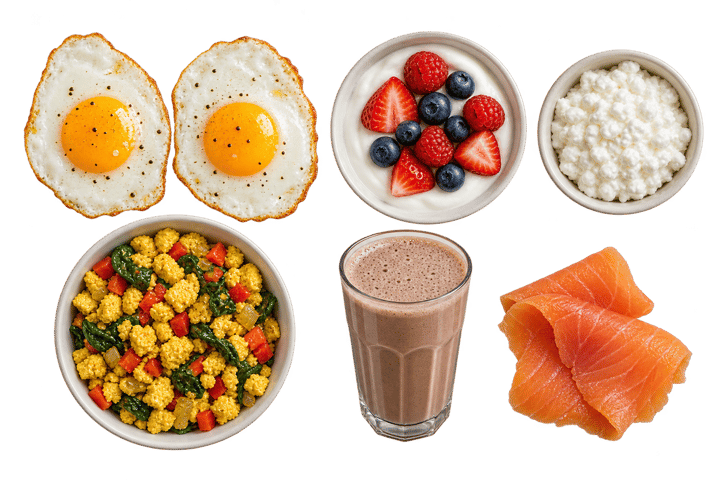
You have to eat protein within 30 minutes of a workout
Short answerNo
On this page
No. When researchers pooled 23 studies of protein timing, eating protein right around a workout made no difference to muscle growth once the day’s total protein was counted, and the total was the strongest predictor of growth. Eat a normal meal with protein in the hours before or after you train, whenever it suits you.
What we’d do
Forget the stopwatch. Reach your daily range, make each meal clear your meal line, and eat one of those meals within a few hours of training if that’s convenient, since the window is wide. If you train before breakfast, breakfast is a fine time for protein. If you train after work, so is dinner.
If you remember three things
- Timing made no difference once total protein was counted, across 23 studies.
- The day’s total was the strongest predictor of muscle growth.
- The window is wide. The muscle stays more responsive to protein for at least a day after training.
Why people believe it
Plenty of people drink a shake before they’ve left the gym, worried they’ll miss it. The idea behind it sounds like science. Lifting breaks muscle down, the muscle is hungry for amino acids right after, and if you miss the 30 to 60 minute “anabolic window”, the chance to grow is gone.
Part of it is true. Muscle does respond more strongly to protein after a workout. The deadline is the part that doesn’t hold up.
What the studies found
In 2013, Brad Schoenfeld, Alan Aragon and James Krieger pooled the trials that compared protein timed around a workout with protein at other times. For muscle size, they had 23 studies and 525 people.
At first glance, timing seemed to help a little. Then they looked more closely. In most of the trials, the two groups didn’t eat the same total protein over the day. Once the researchers accounted for total protein, the timing effect disappeared. The day’s total was the strongest predictor of how much muscle people gained. For strength, timing made no difference at all.
They wrote that the results “refute the commonly held belief that the timing of protein intake in and around a training session is critical”.
23 studies of protein timing
525 people. Schoenfeld, Aragon and Krieger, 2013
Once total protein was accounted for, timing around the workout made no difference to muscle growth or strength. Total protein was the strongest predictor of growth.
Only a few of the trials gave both groups the same total, so the analysis had to adjust for it statistically.
Casein by day or by night
13 men, 10 weeks. Joy and colleagues, 2018
Both groups ate the same 1.8 g per kg a day and took 35 g of casein either in the daytime or before bed. Muscle size and strength rose the same in both.
Small, and the authors called it preliminary.
Protein before bed, or none
44 young men, 12 weeks. Snijders and colleagues, 2015
27.5 g of protein each night beat a placebo with no protein, for both strength and size.
The protein group also ate more protein over the day, about 1.9 against 1.3 g per kg, so it shows that more protein helped, and says nothing about bedtime.
The window is a day wide
A 2015 review noted that the muscle stays more responsive to protein for at least 24 hours after a workout, and that the window “does not have as drastic an effect on outcomes as has been believed”.
Think of watering a garden on a hot week. Whether you water at 7:00 or 7:30 doesn’t decide how the plants do. Whether they got enough water over the week does. Protein after a workout works the same way, on a scale of days.
A 2023 trial adds one more reason not to rush. Young men who drank 100 g of protein after training kept building muscle for more than 12 hours. A meal you eat an hour or two later is still well inside the time your muscle is building.
Where timing can help
There are a few cases where timing can help. If you train hard fasted, first thing in the morning, you’ve gone many hours without protein, and a breakfast with protein afterward makes sense. If you train twice a day, you’ll want protein between sessions. And if a shake after the gym is the only way you’d reach your daily range, it’s a fine habit.
In all three, the shake works because it adds to the day, or keeps a long gap from getting longer. The clock on the wall has little to do with it.
What decides muscle growth instead
The lifting comes first. In the 2018 review of 49 lifting trials, extra protein added about 0.3 kg of lean mass over programs of six weeks or more, on top of what the training itself built. Gains leveled off at about 1.6 g per kg a day. Timing didn’t come into it.
The order of what counts is lifting, then the day’s protein, then whether each meal has enough. The exact minute you drink a shake is far down the list.
6 sources
- Schoenfeld, Aragon and Krieger, The effect of protein timing on muscle strength and hypertrophy: a meta-analysis, Journal of the International Society of Sports Nutrition, 2013pmc.ncbi.nlm.nih.gov
- Morton, McGlory and Phillips, Nutritional interventions to augment resistance training-induced skeletal muscle hypertrophy, Frontiers in Physiology, 2015pmc.ncbi.nlm.nih.gov
- Joy et al., Daytime and nighttime casein supplements similarly increase muscle size and strength in response to resistance training earlier in the day: a preliminary investigation, Journal of the International Society of Sports Nutrition, 2018pmc.ncbi.nlm.nih.gov
- Snijders et al., Protein ingestion before sleep increases muscle mass and strength gains during prolonged resistance-type exercise training in healthy young men, Journal of Nutrition, 2015pubmed.ncbi.nlm.nih.gov
- Trommelen et al., The anabolic response to protein ingestion during recovery from exercise has no upper limit in magnitude and duration in vivo in humans, Cell Reports Medicine, 2023pmc.ncbi.nlm.nih.gov
- Morton et al., A systematic review, meta-analysis and meta-regression of the effect of protein supplementation on resistance training-induced gains in muscle mass and strength in healthy adults, British Journal of Sports Medicine, 2018pmc.ncbi.nlm.nih.gov