How do you keep muscle while you lose weight?
On this page
Eat 1.2 to 1.6 g of protein per kg a day while you lose weight, counted from a weight near your goal if you have a lot to lose, and lift at least twice a week. If you’re already lean and dieting hard while you lift, go higher, to 2.3 to 3.1 g per kg of lean mass.
What we’d do
On a diet, protein is the one number we’d never cut. Set your daily range from the calculator, hit it every day even on days the calories go over, and put some in every meal so you stay full. Lift at least two days a week, because lifting is what tells your body to keep the muscle. Every few weeks, check that what you’re losing is fat with bodyfat.guide’s fat or muscle check. The Gyroscope app personalizes yours.
If you remember three things
- Some of the weight you lose is lean mass. In one big trial it was about a quarter, on the drug and on placebo alike.
- Protein and lifting together keep it small. In a hard 4-week diet, men on 2.4 g per kg gained lean mass and lost more fat than men on 1.2.
- Your protein fits in fewer calories than you’d think. 105 g of protein fits in about 1,070 calories of real food.
Why dieters lose muscle without noticing
The scale tells you how much weight you lost, and it can’t tell you what kind. Most people assume it’s all fat. Some of it isn’t.
In the SURMOUNT-1 trial of the GLP-1 drug tirzepatide, 160 people had body scans before and after 72 weeks. About 75% of the weight they lost was fat and about 25% was lean mass (muscle, organs and water). The placebo group, who lost much less, lost the same split. That share comes from losing weight, with or without the drug.
Think of a diet as a budget cut. When money gets tight, a company keeps the teams that are busy and cuts the ones nobody uses. Lifting keeps the muscle busy, and protein keeps it supplied. Without those two, muscle is one of the things the body is willing to let go.
Why the range counts near your goal
The typical range is 1.2 to 1.6 g per kg of body weight, from the 2025 to 2030 US Dietary Guidelines. If you have a lot to lose, counting it from today’s weight overshoots, because fat tissue barely needs protein. That’s why the range counts from today’s weight unless more than a fifth of it is to lose, and then from your goal plus a fifth of today’s weight.
| You | Counts from | Too low | Typical | Your meal line |
|---|---|---|---|---|
| 160 lb, losing 15 | 160 lb | under 85 g | 85 to 115 g | 30 g |
| 180 lb, losing 20 | 180 lb | under 100 g | 100 to 130 g | 35 g |
| 210 lb, aiming for 160 | 202 lb | under 110 g | 110 to 145 g | 35 g |
| 250 lb, aiming for 180 | 230 lb | under 125 g | 125 to 165 g | 40 g |
| 300 lb, aiming for 200 | 260 lb | under 140 g | 140 to 190 g | 45 g |
This is the same rule bodyfat.guide and tdee.guide use, so your number matches on all three. bodyfat.guide’s protein calculator adds lean mass if you know your bodyfat.
The trial that tried double
In 2016, researchers at McMaster University in Canada put 40 young men through four hard weeks. Everyone ate about 40% fewer calories than they needed, and everyone trained six days a week, lifting plus interval sprints. The only difference was protein. Half ate 1.2 g per kg a day and half ate 2.4.
| 1.2 g per kg | 2.4 g per kg | |
|---|---|---|
| Lean mass | up 0.1 kg (0.2 lb) | up 1.2 kg (2.6 lb) |
| Fat | down 3.5 kg (7.7 lb) | down 4.8 kg (10.6 lb) |
Both groups held their muscle, which shows how much the training was doing. The higher protein group also gained lean mass and lost more fat, in a month, on a big calorie cut.
These were young men training very hard on a steep diet, so most people won’t need 2.4. But it shows which direction helps when the diet is hard.
Lean and lifting hard
For people who are already lean, lift seriously and diet, the typical range can run short. A 2014 review of 6 studies of trained lifters on diets put their need at 2.3 to 3.1 g per kg of lean mass, higher the leaner they were and the harder they cut. In those studies, the one group that held its muscle while lean and cutting hard, with no new training program to explain it, was also the group eating the most protein, about 2.5 g per kg.
| You | Lean mass | Lean and lifting hard |
|---|---|---|
| 140 lb at 25% bodyfat | 105 lb (48 kg) | 110 to 150 g |
| 160 lb at 20% bodyfat | 128 lb (58 kg) | 135 to 180 g |
| 180 lb at 15% bodyfat | 153 lb (69 kg) | 160 to 215 g |
| 200 lb at 15% bodyfat | 170 lb (77 kg) | 175 to 240 g |
If you don’t know your bodyfat, use the typical range. It’s the right number for most people losing weight.
Protein helps you eat less
The second job protein does on a diet is hunger. Two findings stand behind it.
Across 38 feeding trials where people ate as much as they wanted from set menus, the lower the share of protein, the more calories people ate in total. And digesting protein takes more work than digesting carbs or fat. About 20 to 30% of its calories go into handling it, against 5 to 10% for carbs and 0 to 3% for fat.
There’s a limit. In a 22-person trial in Sydney, cutting protein from 15% to 10% of calories made people eat 12% more, mostly in savory snacks. But raising it to 25% didn’t make them eat less. Protein seems to work like a floor. Too little drives you to eat more, and past enough, more doesn’t keep cutting how much you eat. The myth on protein and fullness goes through it.
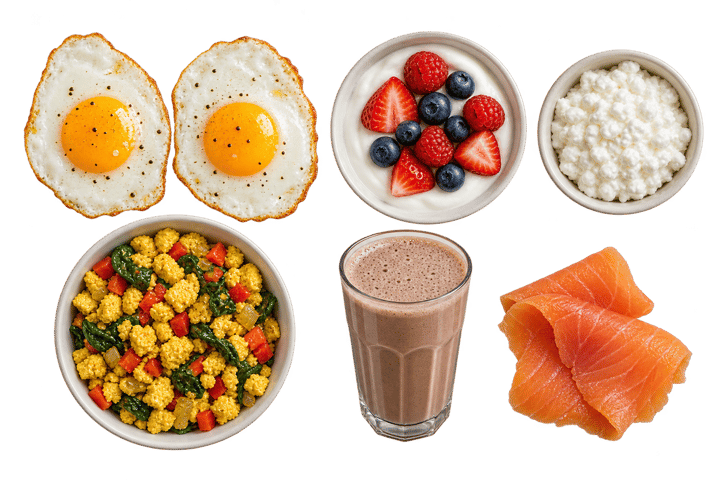
A day of food on 1,500 calories
People worry that a protein range won’t fit on a diet. Here’s a day for someone around 160 lb, with a 30 g meal line, using USDA numbers.
| Meal | What | Protein | Calories |
|---|---|---|---|
| Breakfast | A 5.3 oz cup of nonfat Greek yogurt, two large eggs and a slice of whole wheat toast | 32 g | 313 |
| Lunch | 3 oz of roast turkey breast on two slices of whole wheat bread | 33 g | 278 |
| Dinner | 4 oz of grilled chicken breast and a cup of white rice | 39 g | 376 |
| Snack | A banana | 1 g | 105 |
| Total | 105 g | 1,072 |
That’s 105 g of protein, inside the 85 to 115 g range for 160 lb, with every meal over the line. It leaves about 430 calories for vegetables, cooking oil, fruit and something you like.
On 1,200 calories it gets harder. 100 g of protein is 400 calories, a third of the day, so every meal needs one food that carries a lot of protein for its calories. tdee.guide covers whether 1,200 calories is too low, and our foods section ranks the foods that make it work.
The case that protein barely helps on a diet
The evidence for the average dieter is real but modest, and it’s fair to say so. In a 2026 review of 22 trials in adults without kidney disease, high-protein diets lowered bodyfat percentage and fat mass, but made no clear difference to lean mass. And in a 12-week breakfast trial, a 35 g protein breakfast did no better than a 13 g one.
We’d still put protein first on a diet, for two reasons. Its effect on hunger works for everyone. And its effect on muscle grows the leaner you are and the harder you diet, which is where the Longland and Helms results come from. If you’re lean and cutting hard, protein and lifting decide a lot of the result.
After the diet
Keep the protein when the diet ends. Your range at maintenance is the same number, counted from your new weight, and it keeps helping with hunger while your weight settles. bodyfat.guide covers whether you lose muscle in a calorie deficit and how to build muscle back after a cut.
12 sources
- Look et al., Body composition changes during weight reduction with tirzepatide in the SURMOUNT-1 study of adults with obesity or overweight, Diabetes, Obesity and Metabolism, 2025pubmed.ncbi.nlm.nih.gov
- Longland et al., Higher compared with lower dietary protein during an energy deficit combined with intense exercise promotes greater lean mass gain and fat mass loss: a randomized trial, American Journal of Clinical Nutrition, 2016pubmed.ncbi.nlm.nih.gov
- Helms, Zinn, Rowlands and Brown, A systematic review of dietary protein during caloric restriction in resistance trained lean athletes: a case for higher intakes, International Journal of Sport Nutrition and Exercise Metabolism, 2014pubmed.ncbi.nlm.nih.gov
- Teixeira Silva et al., Effects of high-protein diets on renal function and body composition in adults without chronic kidney disease: a systematic review and meta-analysis of randomised trials, Diabetes, Obesity and Metabolism, 2026pubmed.ncbi.nlm.nih.gov
- Gosby et al., Protein leverage and energy intake, Obesity Reviews, 2014pubmed.ncbi.nlm.nih.gov
- Raubenheimer and Simpson, Protein appetite as an integrator in the obesity system: the protein leverage hypothesis, Philosophical Transactions of the Royal Society B, 2023pmc.ncbi.nlm.nih.gov
- Westerterp, Diet induced thermogenesis, Nutrition and Metabolism, 2004pmc.ncbi.nlm.nih.gov
- US Department of Agriculture and US Department of Health and Human Services, Dietary Guidelines for Americans, 2025 to 2030, January 2026cdn.realfood.gov
- Scientific Foundation for the Dietary Guidelines for Americans, 2025 to 2030cdn.realfood.gov
- CDC, Adult activity: an overview, 2023cdc.gov
- USDA National Agricultural Library, Food and Nutrition Information Centernal.usda.gov
- USDA FoodData Central, SR Legacy records 170894, 171287, 172688, 174516, 171534, 168878 and 173944fdc.nal.usda.gov