How much protein do you need after 50?
On this page
At least the typical 1.2 to 1.6 g per kg a day, and bigger meals. In pooled lab studies, men around 71 needed about 0.4 g of protein per kg in one meal to get muscle building to its peak, against 0.24 for men around 22. For a 165 lb person that’s about 30 g a meal instead of 18. Start with breakfast. The Gyroscope app personalizes yours.
A lot of people eat less as they get older, and it seems natural that they’d need less protein too. Appetite drops, portions shrink, and toast and tea become breakfast. The 2025 to 2030 US Dietary Guidelines say the opposite about protein. Some older adults need fewer calories, they say, but equal or greater amounts of protein.
We’d keep the same daily range after 50, put a meal line under every meal, and lift weights twice a week. The meal line counts for more with age, because the same breakfast that did the job at 25 falls short at 70.
Older muscle is like an older radio. It still plays the song, but you have to turn the volume up to hear it as well.
The meal that got bigger
In 2015, Daniel Moore and colleagues pooled lab studies that fed men different amounts of protein in one sitting and measured how fast their muscle was built afterward. Building leveled off at about 0.24 g per kg of body weight in men around 22, and at about 0.40 g per kg in men around 71. Per kg of lean mass the gap was larger and clear. Per kg of body weight, it fell just short of statistical significance.
| For a 165 lb person | Protein at one meal | A breakfast that gets there |
|---|---|---|
| Around 22 | about 18 g | 3 large eggs (19 g) |
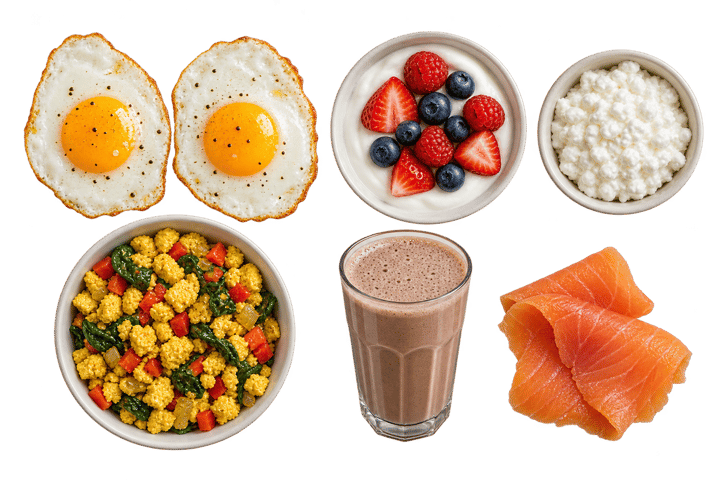
| Around 71 | about 30 g | a 5.3 oz Greek yogurt, 2 eggs and a slice of whole wheat toast (32 g) |
That’s why our meal line uses 0.4 g per kg at every age. Find yours in the meal line calculator, which shows both marks.
The daily number
The PROT-AGE Study Group, an international expert group, recommended in 2013 that people over 65 eat at least 1.0 to 1.2 g per kg a day, 1.2 to 1.5 with an acute or long-term illness, and at least 1.2 for people who exercise. The US guideline’s 1.2 to 1.6 sits at or above all of those. The exception is severe kidney disease, where PROT-AGE says protein may need to be limited. See protein with kidney disease.
Many older Americans are well under even the old minimum. In a national survey of 11,680 adults over 50, up to 46% of those 71 and older ate less than 0.8 g per kg a day. The people below it had more trouble with everyday physical tasks, in every age group. That kind of study can’t prove the protein caused it, but it shows who’s at risk.
Lifting gives the protein a job
Protein supplies the parts, and lifting is what tells the body to build. Two sessions a week of anything that makes your muscles work hard, like weights, bands or getting up from a chair without your hands, gives the protein a reason to stay as muscle. lifespan.guide explains why strong legs decide how long you stay independent, and has a floor test you can do at home.
Plant protein after 60
In a 2025 review of randomized trials, plant protein built slightly less muscle than animal protein overall, but in adults 60 and over there was no clear difference. Beans, lentils, tofu and soy milk all count. See how much protein vegans need.
What we’d do after 50
- Find your range and meal line in the daily range calculator.
- Fix breakfast first. Toast and tea is about 4 g of protein. A Greek yogurt and two eggs is 28 g.
- Lift twice a week. See lifespan.guide on living longer after 65.
- Check your kidneys if you have diabetes or high blood pressure. The 2024 kidney guideline also suggests higher protein and calorie targets for frail older adults, which is a conversation for your doctor.
The myth that you need less protein as you get older has the long version. The quiz checks your three meals against your line in two minutes.
7 sources
- Moore et al., Protein ingestion to stimulate myofibrillar protein synthesis requires greater relative protein intakes in healthy older versus younger men, Journals of Gerontology Series A, 2015pubmed.ncbi.nlm.nih.gov
- Bauer et al., Evidence-based recommendations for optimal dietary protein intake in older people: a position paper from the PROT-AGE Study Group, Journal of the American Medical Directors Association, 2013pubmed.ncbi.nlm.nih.gov
- Krok-Schoen et al., Low dietary protein intakes and associated dietary patterns and functional limitations in an aging population: a NHANES analysis, Journal of Nutrition, Health and Aging, 2019pmc.ncbi.nlm.nih.gov
- US Department of Agriculture and US Department of Health and Human Services, Dietary Guidelines for Americans, 2025 to 2030, January 2026cdn.realfood.gov
- Reid-McCann et al., Effect of plant versus animal protein on muscle mass, strength, physical performance, and sarcopenia: a systematic review and meta-analysis of randomized controlled trials, Nutrition Reviews, 2025pmc.ncbi.nlm.nih.gov
- KDIGO CKD Work Group, KDIGO 2024 clinical practice guideline for the evaluation and management of chronic kidney disease, Kidney International, 2024kdigo.org
- USDA FoodData Central, SR Legacy records 171287 (egg), 170894 (nonfat Greek yogurt) and 172688 (whole wheat bread)fdc.nal.usda.gov