Eating more protein makes you eat less
Short answerYes, but
On this page
Yes, but mostly in one direction. Across 38 feeding trials, people ate fewer calories when more of their food was protein. In one careful trial, cutting protein from 15% to 10% of calories made people eat 12% more, but raising it to 25% didn’t make them eat less. Too little protein drives you to eat more, and past enough, the effect fades.
What we’d do
Use protein to stop the overeating that comes from too little of it. Get every meal to your meal line, starting with breakfast, and don’t expect protein far past your range to shrink your appetite further. If you’re losing weight, protein is the first thing to get right, because a low-protein day is the one that ends with you in the snack cupboard.
If you remember three things
- Low protein makes people eat more. 12% more calories when protein dropped to 10%.
- High protein didn’t make them eat less. Going from 15% to 25% changed nothing.
- Digesting protein costs 20 to 30% of its calories. More than carbs or fat.
Why people believe it
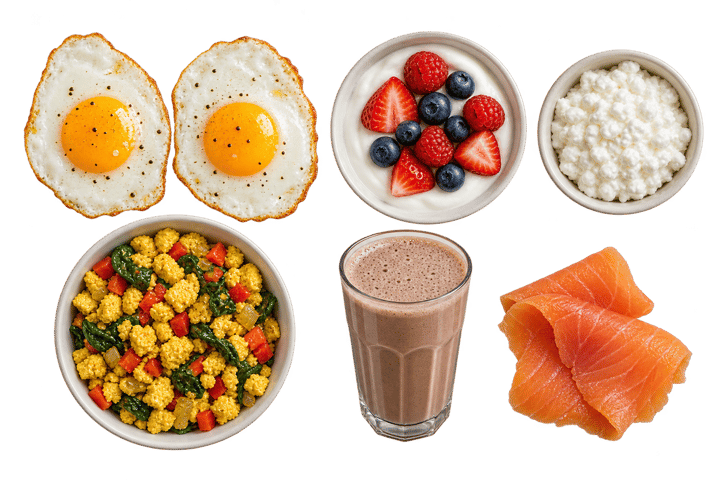
Most people have felt it. A breakfast of eggs and Greek yogurt keeps you going until lunch, and a pastry has you hungry by 10. Plenty of diet advice is built on that feeling.
It’s mostly true. The interesting part is that it’s true in a lopsided way.
The trial in a Sydney sleep center
In a study described in a 2023 review by David Raubenheimer and Stephen Simpson, 22 lean people lived at a University of Sydney sleep center for three stretches of four days. Each stretch, every food on the menu came in one of three versions, with 10%, 15% or 25% of its calories from protein. The researchers matched the versions for taste, so the food seemed the same each week. People ate as much as they wanted.
On the 10% protein menu, people ate 12% more calories, starting on the first day. About 70% of the extra came from snacks between meals, and they reached for savory snacks over sweet ones, as if they were hunting for protein. On the 25% menu, they ate about the same as on 15%.
The authors call this protein leverage. People seem to eat until they’ve had enough protein. When food is low in protein, they eat more of it to get there. When food is high in protein, they reach their protein sooner, but they don’t eat much less overall.
Think of a fuel gauge with a red zone. When protein runs low, the warning light comes on and you keep eating. Once you’re above the line, the light is off, and more protein doesn’t turn it off any harder.
What the bigger picture shows
38 feeding trials
Gosby, Conigrave, Raubenheimer and Simpson, Obesity Reviews, 2014
In trials where people ate as much as they wanted from set menus, protein ranged from 8% to 54% of calories. The lower the share of protein, the more total calories people ate, whether carbs or fat made up the difference.
Pooled from many short trials with different designs.
Protein breakfast, 6 days
20 young women who usually skipped breakfast. Leidy and colleagues, 2013
A 350 calorie breakfast with 35 g of protein raised fullness more than one with 13 g, lowered the hunger hormone ghrelin, and cut evening snacking on high-fat foods compared with skipping.
Small and short, and the main contrast was against skipping.
Protein breakfast, 12 weeks
57 young adults who usually skipped breakfast. Leidy and colleagues, 2015
The 35 g breakfast prevented fat gain and cut daily intake compared with skipping. Against a 13 g breakfast, it made no measurable difference.
The benefit was against skipping breakfast, not against a normal breakfast.
Digestion takes a cut
Protein has one more effect that’s separate from appetite. Your body spends about 20 to 30% of protein’s calories digesting and processing it, against 5 to 10% for carbs and 0 to 3% for fat. Protein has 4 calories per gram, so 100 g of protein is 400 calories, and roughly 80 to 120 of those go into handling it.
That makes protein a little cheaper in calories than it looks on the label. It isn’t a fat burner, and it won’t undo a big surplus, but on a diet it helps at the edges.
Where the belief goes too far
The one-way result is the part most people miss. If you already eat enough protein, adding more won’t keep shrinking your appetite. In the Sydney trial, 25% protein didn’t lower intake below 15%. And in the 12-week breakfast trial, 35 g at breakfast did no better than 13 g.
The useful version of the advice is about not going low. Most American adults eat about 15 g of protein at breakfast, and many eat less than their range over the day. That’s the zone where protein does the most for appetite. Getting each meal to your line covers it, and the quiz shows which of your meals runs lowest.
tdee.guide covers the other meal myth people pair with this one: do six small meals a day speed up your metabolism?
6 sources
- Gosby et al., Protein leverage and energy intake, Obesity Reviews, 2014pubmed.ncbi.nlm.nih.gov
- Raubenheimer and Simpson, Protein appetite as an integrator in the obesity system: the protein leverage hypothesis, Philosophical Transactions of the Royal Society B, 2023pmc.ncbi.nlm.nih.gov
- Westerterp, Diet induced thermogenesis, Nutrition and Metabolism, 2004pmc.ncbi.nlm.nih.gov
- Leidy et al., Beneficial effects of a higher-protein breakfast on the appetitive, hormonal, and neural signals controlling energy intake regulation in overweight/obese, breakfast-skipping, late-adolescent girls, American Journal of Clinical Nutrition, 2013pubmed.ncbi.nlm.nih.gov
- Leidy et al., a 12-week randomized trial of higher-protein and normal-protein breakfasts in breakfast-skipping adolescents, Obesity, 2015pubmed.ncbi.nlm.nih.gov
- USDA National Agricultural Library, Food and Nutrition Information Centernal.usda.gov