Is pea protein as good as whey?
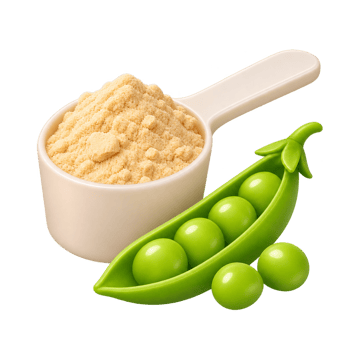
Close, if you use a bigger scoop. Pea protein is about 7% leucine, the amino acid most tied to switching on muscle building, against about 11% in whey. About 38 g of pea protein gives the same leucine as 25 g of whey, about 1.5 scoops. Soy protein matched milk protein for muscle in 17 trials.
The plant protein argument usually runs on vibes. One side says plant protein is “incomplete” and can’t build muscle. The other says protein is protein. The useful middle is that plant proteins differ from whey in how much leucine they carry per gram, and you can make up most of that difference by eating more of them.
We’d treat pea protein as a good whey swap at about one and a half scoops, and soy as a near-equal at a normal scoop. If you’re vegan or can’t do dairy, a soy powder, or a pea and rice blend, does the job. If you’re fine with dairy and only care about muscle per scoop, whey is the most efficient.
It’s like a weaker coffee. Use a bigger scoop and it does the job.
The leucine math
In 2018, Stefan Gorissen and colleagues measured the amino acids in a long list of protein powders.
| Powder | Leucine | Grams of protein for 2.7 g of leucine |
|---|---|---|
| Whey | about 11% | 25 g |
| Pea | about 7% | 38 g |
| Soy | about 7% | 40 g |
Plant proteins in their analysis averaged 7.1% leucine, and animal proteins 8.8%. The 38 g and 40 g come from their table, and the percentages are our arithmetic from it.
Leucine counts because it works as a signal for muscle building in lab studies. Nobody has shown a sharp threshold in grams that a meal has to cross.
What the trials found
Lab numbers are one thing, and muscle over months is another. A 2025 review by Reid-McCann and colleagues pooled randomized trials of plant against animal protein.
| Comparison | Effect on muscle mass | Strength |
|---|---|---|
| Plant against animal protein, overall | slightly less with plant | no difference |
| Soy against milk protein (17 trials) | no difference | |
| Non-soy plant proteins (5 trials) | well short | |
| In adults 60 and over | no clear difference |
Soy did as well as milk. Single plant proteins other than soy fell short in the trials that tested them, which is why a bigger scoop or a blend makes sense for pea.
Whole diets tell the same story. In a 2023 trial, 22 young adults lifted hard for 10 weeks on about 2 g of protein per kg, either vegan (with mycoprotein, a fungus-based protein) or with meat and dairy. The vegan group gained 6.8 lb (3.1 kg) of lean mass and the omnivores 5.7 lb (2.6 kg), and thigh muscle grew 8.3% in both. The difference wasn’t significant. See the myth that plant protein can’t build muscle like meat.
How we’d use it
- Pea powder: about 1.5 scoops to match one scoop of whey for leucine, or 38 g of pea protein for 25 g of whey.
- Soy powder: a normal scoop, about 40 g of soy protein for the same leucine.
- Blends: pea and rice is common. The 2025 to 2030 US Dietary Guidelines tell vegans to vary their plant protein sources for a better balance of amino acids.
Hit your daily range first. The scoop size only makes a difference once the total is there. See how much protein vegans need, and our plants guide for the whole picture. If you’d rather skip powder, the best plant-based protein sources and how to get enough protein without powder cover it with food.
4 sources
- Gorissen et al., Protein content and amino acid composition of commercially available plant-based protein isolates, Amino Acids, 2018pmc.ncbi.nlm.nih.gov
- Reid-McCann et al., Effect of plant versus animal protein on muscle mass, strength, physical performance, and sarcopenia: a systematic review and meta-analysis of randomized controlled trials, Nutrition Reviews, 2025pmc.ncbi.nlm.nih.gov
- Monteyne et al., Vegan and omnivorous high protein diets support comparable daily myofibrillar protein synthesis rates and skeletal muscle hypertrophy in young adults, Journal of Nutrition, 2023pmc.ncbi.nlm.nih.gov
- US Department of Agriculture and US Department of Health and Human Services, Dietary Guidelines for Americans, 2025 to 2030, January 2026cdn.realfood.gov