How much protein do I need a day?
On this page
Aim for 1.2 to 1.6 g of protein per kg of body weight a day. At 180 lb that’s about 100 to 130 g, or 35 to 45 g at each of three meals. Under that is too low, and many people are. Put your weight in the daily range calculator to see yours in grams and as food. The Gyroscope app personalizes yours.
Most websites still give you 0.8 g per kg. That’s the RDA, the amount set to cover basic needs in nearly all healthy adults, and it sticks around because it’s the official-looking number. At 180 lb it works out to 65 g. In January 2026 the US Dietary Guidelines moved the goal to 1.2 to 1.6 g per kg, and the report behind them puts the average American adult at about 1 g per kg. Most people sit in the gap between the old floor and the new range.
We’d aim for the range, count it from today’s weight (or nearer your goal if you have a lot to lose), and find the missing grams at breakfast, where most people eat the least. Then lift weights twice a week so the protein has a job to do. Skip the gram-per-pound rule unless you’re lean and lifting hard.
The RDA works like the minimum payment on a credit card. It keeps you out of trouble, but it was never meant to be the amount you aim for.
Your range by weight
| You weigh | Too low | Typical | Your meal line |
|---|---|---|---|
| 120 lb | under 65 g | 65 to 85 g | 20 g |
| 140 lb | under 75 g | 75 to 100 g | 25 g |
| 160 lb | under 85 g | 85 to 115 g | 30 g |
| 180 lb | under 100 g | 100 to 130 g | 35 g |
| 200 lb | under 110 g | 110 to 145 g | 35 g |
| 220 lb | under 120 g | 120 to 160 g | 40 g |
| 250 lb, aiming for 180 | under 125 g | 125 to 165 g | 40 g |
Grams are rounded to 5, the same as the calculators on bodyfat.guide and tdee.guide, so you get one number across the guides. The meal line is about 0.4 g per kg, the amount at one meal where muscle building leveled off in older men. How much protein per meal explains it.
The last row isn’t counted from 250 lb. If you have more than a fifth of your weight to lose, count from your goal plus a fifth of what you weigh today, which is 230 lb here. Goal weight or current weight shows why.
Where 1.2 to 1.6 comes from
The RDA is there to prevent a shortfall, like losing lean mass on a diet that’s too low. The guideline’s range comes from asking whether eating more than that does anything useful. A review of 30 trials, mostly in adults losing weight, compared 1.2 to 1.6 g per kg against 0.8 to 1.0. Two thirds of the trials found a gain in at least one result, like more fat lost or more lean mass kept, and none found harm. Across them, people on more protein lost about 3 lb (1.3 kg) more fat and kept about 1.8 lb (0.8 kg) more lean mass.
The muscle studies land in the same place. In a 2018 review of 49 trials with 1,863 people who lifted, the extra muscle from more protein leveled off at about 1.6 g per kg a day. The researchers weren’t certain of that point, and the top of their range was 2.2.
Not everyone agrees with the new range. A 2026 paper by Pasiakos and colleagues argues that it rests mostly on weight-loss trials, which they say is too narrow a base for every adult. That’s a fair point about the evidence. But the range sits well inside what’s safe, and the report behind the guidelines found no upper limit for protein.
What 100 g looks like
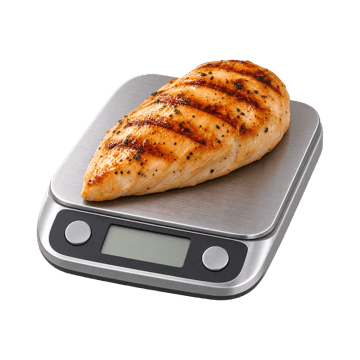
Three large eggs, a 5.3 oz cup of nonfat Greek yogurt, 4 oz of grilled chicken breast, a cup of cooked lentils and half a cup of 1% cottage cheese add up to 101 g of protein, in about 790 calories (USDA). Most people eat a lot less than that. The average American adult eats 77 g a day, with only about 15 g of it at breakfast.
Who needs a different number
- Lean and lifting hard on a diet: 2.3 to 3.1 g per kg of lean mass, from a 2014 review. For a 180 lb man at 15% bodyfat that’s about 160 to 215 g. Add your bodyfat in the calculator to see it.
- Kidney disease: your doctor sets the number. See protein with kidney disease.
- Pregnant or breastfeeding: the US RDA is 71 g a day in the second half of pregnancy. See protein when pregnant.
- Under 18: this guide is written for adults.
Not sure where you are now? Am I eating enough protein? is a two-minute quiz that adds up your normal day against your range.
8 sources
- US Department of Agriculture and US Department of Health and Human Services, Dietary Guidelines for Americans, 2025 to 2030, January 2026cdn.realfood.gov
- Scientific Foundation for the Dietary Guidelines for Americans, 2025 to 2030cdn.realfood.gov
- Institute of Medicine, Dietary Reference Intakes, reference values for macronutrients (2005), Health Canada tablescanada.ca
- USDA Agricultural Research Service, What We Eat in America, NHANES August 2021 to August 2023, Tables 1, 13, 21 and 25ars.usda.gov
- Morton et al., A systematic review, meta-analysis and meta-regression of the effect of protein supplementation on resistance training-induced gains in muscle mass and strength in healthy adults, British Journal of Sports Medicine, 2018pmc.ncbi.nlm.nih.gov
- Helms et al., A systematic review of dietary protein during caloric restriction in resistance trained lean athletes: a case for higher intakes, International Journal of Sport Nutrition and Exercise Metabolism, 2014pubmed.ncbi.nlm.nih.gov
- Pasiakos et al., Perspectives on the protein recommendations in the 2025-2030 Dietary Guidelines for Americans, Journal of Nutrition, 2026pubmed.ncbi.nlm.nih.gov
- USDA FoodData Central, SR Legacy records 171287 (egg), 170894 (nonfat Greek yogurt), 171534 (grilled chicken breast), 172421 (lentils) and 173417 (1% cottage cheese)fdc.nal.usda.gov