Should I eat protein before bed?
On this page
Only if you’re short for the day. Protein before bed helped people who lift when it was extra protein on top of their day. But when the daily total was the same, a 10-week trial found casein in the day did just as well as casein at night. Bedtime is a fine place to add grams, and nothing special happens because it’s bedtime.
The bedtime shake took off with one well-run study and a simple story. Your muscle rebuilds while you sleep, sleep is eight hours without food, so a slow protein like casein before bed should keep the building going all night. It’s a nice story, and the first big trial seemed to back it up.
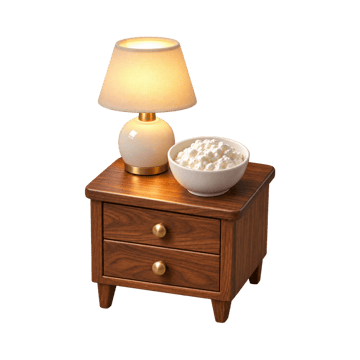
We’d use bedtime protein as a top-up. If you’re 20 g short of your range at 9 pm, a bowl of cottage cheese or Greek yogurt is an easy way to close it. If you’ve already hit your range, a bedtime shake adds calories and not much else.
It’s like paying a bill at 11 pm instead of 9 am. The bank only cares that it got paid.
The trial that started it
In 2015, Tim Snijders and colleagues had 44 young men lift weights for 12 weeks. Every night, half drank 27.5 g of protein before bed and half drank a drink with no protein. The protein group gained more strength, and their thigh muscle grew more, about 8.4 against 4.8 square centimeters in cross-section.
The catch is in the totals. The bedtime group also ate more protein over the whole day, about 1.9 g per kg against 1.3, according to the later trial that pointed it out. The study shows that more protein helped, and it can’t tell you whether bedtime was the reason.
The trial that tested the timing
In 2018, Jordan Joy and colleagues ran the comparison that was missing. Men who lifted took 35 g of casein either at night or during the day, with the same daily protein, about 2 g per kg in both groups. After 10 weeks, 13 men had finished, and the two groups gained the same muscle and strength. It was small, and the authors called it preliminary, but it’s the direct test.
A 2013 review of 23 studies on protein timing around workouts found the same pattern from another angle. Once the researchers accounted for how much protein people ate in total, timing made no difference, and the total was the strongest predictor of muscle growth. See the myth about the 30-minute window after a workout.
Good bedtime protein, if you’re short
| Food | Protein | Calories |
|---|---|---|
| 1 cup 1% cottage cheese | 28 g | 162 |
| 1/2 cup 1% cottage cheese | 14 g | 81 |
| 5.3 oz nonfat Greek yogurt | 15 g | 88 |
| 1 cup 2% milk | 8 g | 122 |
Grams from USDA FoodData Central.
To see whether you’re short in the first place, put your day into Is my number enough?, or take the two-minute quiz. Your three main meals at your meal line do more than any snack at any hour.
4 sources
- Snijders et al., Protein ingestion before sleep increases muscle mass and strength gains during prolonged resistance-type exercise training in healthy young men, Journal of Nutrition, 2015pubmed.ncbi.nlm.nih.gov
- Joy et al., Daytime and nighttime casein supplements similarly increase muscle size and strength in response to resistance training earlier in the day: a preliminary investigation, Journal of the International Society of Sports Nutrition, 2018pmc.ncbi.nlm.nih.gov
- Schoenfeld et al., The effect of protein timing on muscle strength and hypertrophy: a meta-analysis, Journal of the International Society of Sports Nutrition, 2013pmc.ncbi.nlm.nih.gov
- USDA FoodData Central, SR Legacy records 173417 (1% cottage cheese), 170894 (nonfat Greek yogurt) and 171267 (2% milk)fdc.nal.usda.gov