How much protein should a woman eat a day?
The same 1.2 to 1.6 g of protein per kg of body weight a day as anyone. At 140 lb that’s about 75 to 100 g, with about 25 g at each meal. Your weight sets the number, the same as for a man. The hard part is fitting it into fewer calories. The Gyroscope app personalizes yours.
The number most women have seen is 46 g. It comes from the US tables, where the RDA of 0.8 g per kg is shown at a reference weight, and for women that works out to 46 g. It’s printed on so many charts that it looks like the answer for every woman. It’s the minimum for a woman of about 127 lb.
We’d ignore the 46 g and use the range for your weight. Then we’d fix breakfast, because a smaller calorie budget leaves less room for a light first meal. The national food survey for 2021 to 2023 found American women average about 66 g of protein a day, which is under the range for most adult women.
It’s like a smaller grocery budget. The staples cost the same, so they take up a bigger share of it.
The range by weight
| You weigh | Too low | Typical | Your meal line |
|---|---|---|---|
| 120 lb | under 65 g | 65 to 85 g | 20 g |
| 130 lb | under 70 g | 70 to 95 g | 25 g |
| 140 lb | under 75 g | 75 to 100 g | 25 g |
| 150 lb | under 80 g | 80 to 110 g | 25 g |
| 160 lb | under 85 g | 85 to 115 g | 30 g |
| 180 lb | under 100 g | 100 to 130 g | 35 g |
From the same function as the daily range calculator, rounded to 5. If you have more than a fifth of your weight to lose, it counts from your goal plus a fifth of today’s weight.
Why it’s harder on fewer calories
Protein has 4 calories per gram (USDA), so 90 g is 360 calories wherever you eat it. On a smaller budget, that’s a bigger slice.
| Protein | On 2,000 calories | On 1,800 | On 1,500 |
|---|---|---|---|
| 75 g | 15% | 17% | 20% |
| 90 g | 18% | 20% | 24% |
| 100 g | 20% | 22% | 27% |
All of these sit inside the US acceptable range of 10 to 35% of calories. The trick is the foods. At 1,500 calories there’s little room for protein that comes with a lot of fat or starch. See why you can’t hit your protein on 1,200 calories.
A 90 g day
| Meal | Food | Protein |
|---|---|---|
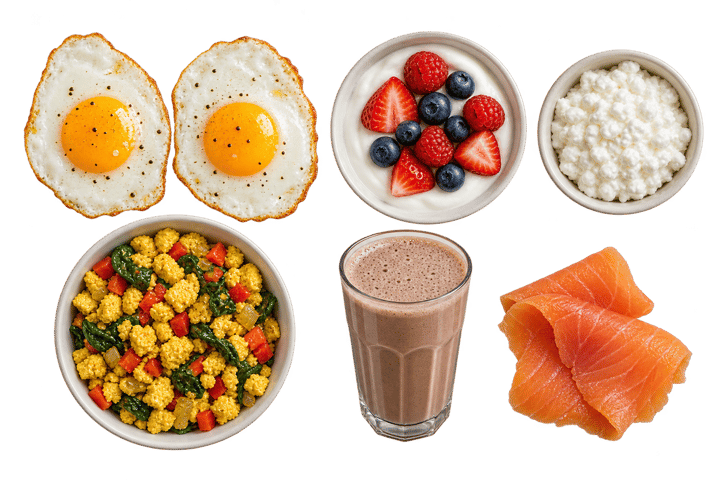
| Breakfast | A 5.3 oz nonfat Greek yogurt and 2 eggs | 28 g |
| Lunch | 3 oz canned tuna on two slices of whole wheat | 25 g |
| Dinner | 3 oz grilled chicken breast | 26 g |
| Snack | 1/2 cup 1% cottage cheese | 14 g |
| The day | about 92 g, in about 680 calories before sides |
Grams from USDA FoodData Central.
When the number changes
- Pregnant or breastfeeding. The US RDA is 1.1 g per kg (71 g) in the second half of pregnancy and 1.3 g per kg while breastfeeding. See protein when pregnant.
- Over 50. Same range, bigger meals. In a national survey, up to 46% of adults 71 and older ate less than 0.8 g per kg. See protein after 50.
- Lean and lifting hard on a diet. 2.3 to 3.1 g per kg of lean mass. Add your bodyfat in the calculator.
- Kidney disease. Your doctor sets the number.
The quiz adds up your normal day against your range and finds the one swap that would close the gap.
6 sources
- US Department of Agriculture and US Department of Health and Human Services, Dietary Guidelines for Americans, 2025 to 2030, January 2026cdn.realfood.gov
- Institute of Medicine, Dietary Reference Intakes, reference values for macronutrients (2005), Health Canada tablescanada.ca
- USDA Agricultural Research Service, What We Eat in America, NHANES August 2021 to August 2023, Tables 1, 13, 21 and 25ars.usda.gov
- USDA National Agricultural Library, Food and Nutrition Information Center, calories per gram of proteinnal.usda.gov
- Krok-Schoen et al., Low dietary protein intakes and associated dietary patterns and functional limitations in an aging population: a NHANES analysis, Journal of Nutrition, Health and Aging, 2019pmc.ncbi.nlm.nih.gov
- USDA FoodData Central, SR Legacy records 170894 (nonfat Greek yogurt), 171287 (egg), 173709 (canned light tuna), 172688 (whole wheat bread), 171534 (grilled chicken breast) and 173417 (1% cottage cheese)fdc.nal.usda.gov