Is 200 g of protein a day too much?
On this page
For most people, yes, it’s more than they need. At 180 lb, 200 g is 2.4 g per kg, past the point where extra protein stopped adding muscle in the trials. Healthy kidneys showed no harm in the studies we have, but they were short. It makes sense for people over about 275 lb and for lean lifters on a hard diet.
200 g comes from the gym. It’s the classic bodybuilder number, and it’s what 1 g per pound gives a 200 lb lifter. It spread because it’s simple, and because more sounds safer when you’re trying to build something.
We’d keep 200 g for the people it fits and skip it otherwise. For a 180 lb person who lifts a couple of times a week, 100 to 130 g does the muscle work, and the other 70 to 100 g is mostly expensive calories.
Where 200 g lands at your weight
| You weigh | Typical range | 200 g per kg |
|---|---|---|
| 150 lb | 80 to 110 g | 2.9 g |
| 180 lb | 100 to 130 g | 2.4 g |
| 200 lb | 110 to 145 g | 2.2 g |
| 250 lb | 135 to 180 g | 1.8 g |
| 275 lb | 150 to 200 g | 1.6 g |
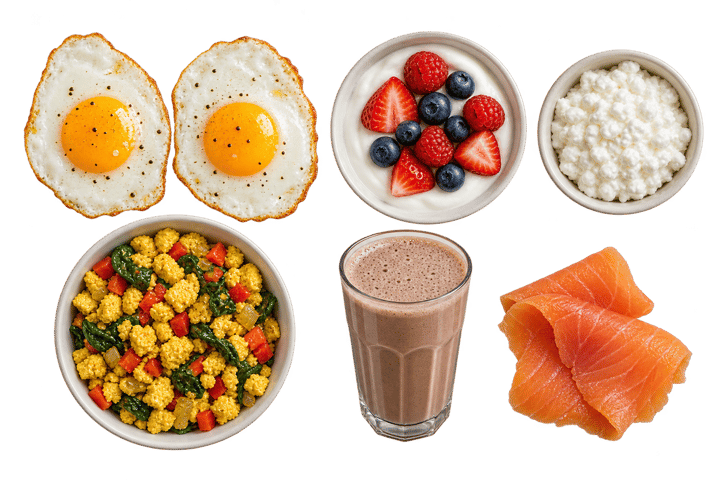
200 g only comes inside the typical range at about 275 lb and up. Is my number enough? shows it for your weight, as meals and as food. At 180 lb it’s about five 4 oz cooked chicken breasts, a Greek yogurt and two eggs.
When 200 g has earned its place
The best case for it is a 2016 trial. Researchers put 40 young men on 40% fewer calories for four weeks, with hard lifting and intervals six days a week. Half ate 2.4 g of protein per kg, which is 200 g at 180 lb. They gained 2.6 lb (1.2 kg) of lean mass and lost 10.6 lb (4.8 kg) of fat. The half on 1.2 g per kg gained 0.2 lb (0.1 kg) of lean mass and lost 7.7 lb (3.5 kg) of fat. That’s a big difference, but it was four weeks of a very hard diet and very hard training, in young men.
A 2014 review found the same for lean lifters on a diet: 2.3 to 3.1 g per kg of lean mass. For a 180 lb man at 12% bodyfat that’s about 165 to 225 g. Add your bodyfat in the daily range calculator to see your own.
Outside a hard diet, the gains stop earlier. In a 2018 review of 49 trials, extra muscle from protein leveled off at about 1.6 g per kg, with an uncertain range up to 2.2. 200 g at 180 lb is past both.
What it costs
200 g of protein is 800 calories, at 4 calories a gram (USDA). On a 2,000 calorie day that’s 40%, which is over the top of the acceptable range of 10 to 35% of calories in the US tables. On a 2,500 calorie day it’s 32%. At that level, protein leaves a lot less room for everything else on the plate.
Eating 200 g when you need 120 is like running the dishwasher for two plates. It works, and most of what you paid for went down the drain.
The report behind the 2025 to 2030 guidelines gives one upper line. It says diets above 3.4 g per kg a day should be avoided because they may lower testosterone in men. That’s about 280 g at 180 lb, well above 200.
What about the kidneys?
In 22 trials in adults without kidney disease, high-protein diets raised the filtering rate (eGFR) and didn’t change creatinine, with no consistent sign of injury. Most of those trials lasted weeks to months. If you have kidney disease, diabetes or high blood pressure, ask your doctor before going this high, and see protein with kidney disease.
For the rule behind the number, see the myth that you need 1 g per pound.
7 sources
- Scientific Foundation for the Dietary Guidelines for Americans, 2025 to 2030cdn.realfood.gov
- Institute of Medicine, Dietary Reference Intakes, reference values for macronutrients (2005), Health Canada tablescanada.ca
- Morton et al., A systematic review, meta-analysis and meta-regression of the effect of protein supplementation on resistance training-induced gains in muscle mass and strength in healthy adults, British Journal of Sports Medicine, 2018pmc.ncbi.nlm.nih.gov
- Longland et al., Higher compared with lower dietary protein during an energy deficit combined with intense exercise promotes greater lean mass gain and fat mass loss, American Journal of Clinical Nutrition, 2016pubmed.ncbi.nlm.nih.gov
- Helms et al., A systematic review of dietary protein during caloric restriction in resistance trained lean athletes: a case for higher intakes, International Journal of Sport Nutrition and Exercise Metabolism, 2014pubmed.ncbi.nlm.nih.gov
- Teixeira Silva et al., Effects of high-protein diets on renal function and body composition in adults without chronic kidney disease, Diabetes, Obesity and Metabolism, 2026pubmed.ncbi.nlm.nih.gov
- USDA National Agricultural Library, Food and Nutrition Information Center, calories per gram of proteinnal.usda.gov