How much protein should I eat to lose weight?
On this page
Eat the typical 1.2 to 1.6 g of protein per kg a day, counted from today’s weight, or from nearer your goal if you have more than a fifth of your weight to lose. That’s 110 to 145 g at 200 lb, and 125 to 165 g at 250 lb aiming for 180. Lean people who lift hard on a tough diet need 2.3 to 3.1 g per kg of lean mass. The Gyroscope app personalizes yours.
Most diets are built around cutting something: carbs, fat, sugar, meals. Protein gets cut along with everything else, because eating less food means eating less of all of it. That’s the problem. When you eat less than you burn, the body makes up the gap from fat and from muscle, and protein is one of the two things that tilt it toward fat.
We’d do three things. Hit your range every day, counted from the right weight. Put protein first at each meal, so it’s the part that survives when portions shrink. And lift weights at least twice a week, because the protein needs a reason to stay as muscle.
Think of a diet as a sale where the body sells off a bit of everything. Protein and lifting put a “not for sale” sign on the muscle.
Your range while losing
| You | Typical while losing | Your meal line |
|---|---|---|
| 160 lb, aiming for 140 | 85 to 115 g | 30 g |
| 200 lb, aiming for 170 | 110 to 145 g | 35 g |
| 250 lb, aiming for 180 | 125 to 165 g | 40 g |
| 300 lb, aiming for 200 | 140 to 190 g | 45 g |
The top two rows count from today’s weight because their loss is under a fifth. The bottom two count from the goal plus a fifth of today’s weight. Goal weight or current weight has the reasoning, and the daily range calculator does the math.
What protein does on a diet
The 2025 to 2030 US guidelines rest their range on a review of 30 trials, mostly in adults losing weight. People on 1.2 to 1.6 g per kg lost about 3 lb (1.3 kg) more fat and kept about 1.8 lb (0.8 kg) more lean mass than people on 0.8 to 1.0, and no trial found harm.
How much lean mass goes depends a lot on the diet. In the body-scan study inside the SURMOUNT-1 tirzepatide trial, about a quarter of the weight people lost was lean mass, and that was true in the placebo group too. Losing weight takes some lean mass with it, drug or no drug.
In a 2016 trial, 40 young men ate 40% fewer calories for four weeks and trained hard six days a week. On 2.4 g of protein per kg, they gained 2.6 lb (1.2 kg) of lean mass and lost 10.6 lb (4.8 kg) of fat. On 1.2 g they gained 0.2 lb (0.1 kg) of lean mass and lost 7.7 lb (3.5 kg) of fat. A 2014 review of six studies found the same thing for lean lifters on a diet, and put them at 2.3 to 3.1 g per kg of lean mass. For a 180 lb man at 15% bodyfat, that’s about 160 to 215 g.
Protein and hunger
Protein helps a little with the calories too. Digesting it uses 20 to 30% of its own calories, against 5 to 10% for carbs and 0 to 3% for fat. And in a 22-person trial, cutting protein from 15% to 10% of calories made people eat 12% more, mostly in snacks. Raising it to 25% didn’t make them eat less, though. Protein helps you avoid overeating when it’s low, and it isn’t an appetite switch. See the myth that more protein makes you eat less.
How to eat it on fewer calories
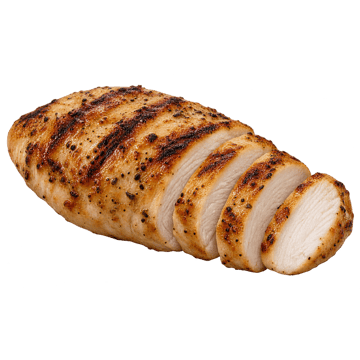
On a diet, protein takes up a bigger share of a smaller plate. 120 g of protein is 480 calories, about a third of a 1,500 calorie day. Foods with 15 g or more of protein per 100 calories make that fit, like chicken breast, canned tuna, shrimp, nonfat Greek yogurt and 1% cottage cheese. See why you can’t hit your protein on 1,200 calories and the ranked list in protein per calorie.
To check that what you’re losing is fat, use bodyfat.guide’s fat or muscle check and its answer on losing muscle in a calorie deficit. On a GLP-1, see protein on Ozempic or Mounjaro.
7 sources
- US Department of Agriculture and US Department of Health and Human Services, Dietary Guidelines for Americans, 2025 to 2030, January 2026cdn.realfood.gov
- Scientific Foundation for the Dietary Guidelines for Americans, 2025 to 2030cdn.realfood.gov
- Longland et al., Higher compared with lower dietary protein during an energy deficit combined with intense exercise promotes greater lean mass gain and fat mass loss, American Journal of Clinical Nutrition, 2016pubmed.ncbi.nlm.nih.gov
- Helms et al., A systematic review of dietary protein during caloric restriction in resistance trained lean athletes: a case for higher intakes, International Journal of Sport Nutrition and Exercise Metabolism, 2014pubmed.ncbi.nlm.nih.gov
- Look et al., Body composition changes during weight reduction with tirzepatide in the SURMOUNT-1 study of adults with obesity or overweight, Diabetes, Obesity and Metabolism, 2025pubmed.ncbi.nlm.nih.gov
- Westerterp, Diet induced thermogenesis, Nutrition and Metabolism, 2004pmc.ncbi.nlm.nih.gov
- Raubenheimer and Simpson, Protein appetite as an integrator in the obesity system: the protein leverage hypothesis, Philosophical Transactions of the Royal Society B, 2023pmc.ncbi.nlm.nih.gov